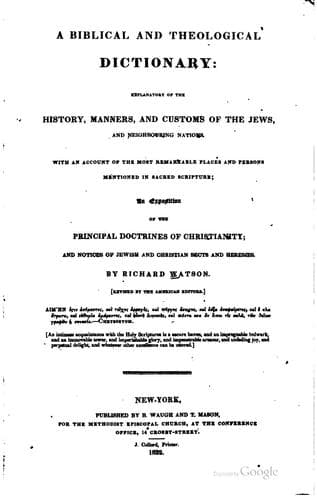
A Biblical and Theological Dictionary: explanatory of the history, manners, and customs of the Jews, and neighbouring nationsWatson, Richard
Religion
A Biblical and Theological Dictionary: explanatory of the history, manners, and customs of the Jews, and neighbouring nations
Watson, Richard
Bible -- Dictionaries; Theology -- Dictionaries
The Jews held this Word, or Angel of the Lord, to be the future Messiah,
as appears from the writings of their older rabbins. So that he appears
as the Jehovah of all the three dispensations, and yet is invariably
described as a separate person from the unseen Jehovah who sends him. He
was then the Word to be made flesh, and to dwell for a time among us, to
open the way to God by his sacrifice, and to rescue the race, whose
nature he should assume, from sin and death. This he has now actually
effected; and the Patriarchal, Mosaic, and Christian religions are thus
founded upon the same great principles,--the fall and misery of mankind,
and their deliverance by a _Divine Redeemer_.
ANGELICS, worshippers of angels. Those who consider this as a sect of
the Apostolic age, think St. Paul, Coloss. ii, 18, cautions Christians
against a superstitious reverence of these celestial agents of the
Deity, which they conceive to have been borrowed from the idolatrous
reverence paid by the Heathen to genii and demons. The Jews of that time
are also accused of worshipping angels, and probably this superstition
might through them influence the Judaizing members of some of the
Apostolic churches. This idolatry may now be too justly charged upon the
Romish and some other corrupt churches.
ANGER, a resentful emotion of the mind, arising upon the receipt, or
supposed receipt, of an affront or injury; and also simple feeling of
strong displacency at that which is in itself evil, or base, or
injurious to others. In the latter sense it is not only innocent but
commendable. Strong displeasure against evil doers, provided it be free
from hatred and malice, and interferes not with a just placableness, is
also blameless, Eph. iv, 26. When it is vindictive against the person of
our neighbour, or against the innocent creatures of God, it is wicked,
Matt. v, 22. When anger, hatred, wrath, and fury, are ascribed to God,
they denote no tumultuous passion, but merely his holy and just
displeasure with sin and sinners; and the evidence of it in his terrible
threatenings, or righteous judgments, Psalm vi, 1, and vii, 11. We must,
however, take care that we refine not too much. These are Scriptural
terms, and are often used of God; and though they express not a
tumultuous, much less an unjust, passion, there is something in God
which answers to them. In him they are _principles_ arising out of his
holy and just nature; and for this reason they are more steady and
uniform, and more terrible, than if they were emotions, or as we say
passions. Nor can we rightly regard the severity of the judgments which
God has so often executed upon sin without standing in awe of him, “as a
consuming fire” to the ungodly.
Public-domain text, read in full here on John Shaqi.
Reviews
Reviews
No reviews yet
Be the first to share your thoughts on this work.
Elsewhere in the archive
Join the Discussion
Join the discussion
Sign in to leave a comment or review.
Sign InorCreate an account