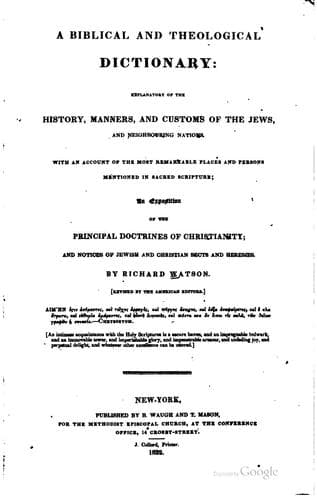
A Biblical and Theological Dictionary: explanatory of the history, manners, and customs of the Jews, and neighbouring nationsWatson, Richard
Religion
A Biblical and Theological Dictionary: explanatory of the history, manners, and customs of the Jews, and neighbouring nations
Watson, Richard
Bible -- Dictionaries; Theology -- Dictionaries
ANIMAL, is an organized and living body, endowed with sensation.
Minerals are said to grow or increase, plants to grow and live, and
animals alone to have sensation. The Hebrews distinguished animals into
pure and impure, clean and unclean; or those which might be eaten and
offered, and those whose use was prohibited. The sacrifices which they
offered, were, 1. Of the beeve kind; a cow, bull, or calf. The ox could
not be offered, because it was mutilated; and when it is said oxen were
sacrificed, we are to understand bulls, Lev. xxii, 18, 19. Calmet
thinks, that the mutilation of animals was neither permitted, nor used,
among the Israelites. 2. Of the goat kind; a he-goat, a she-goat, or
kid, Lev. xxii, 24. 3. Of the sheep kind; a ewe, ram, or lamb. When it
is said sheep are offered, rams are chiefly meant, especially in
burnt-offerings and sacrifices for sin; for as to peace-offerings, or
sacrifices of pure devotion, a female might be sometimes offered,
provided it was pure, and without blemish, Lev. iii, 1.
Besides these three sorts of animals, used in sacrifices, many others
might be eaten, wild or tame; as the stag, the roe-buck, and in general
all that have cloven feet, or that chew the cud, Lev. ix, 2, 3, &c. All
that have not cloven hoofs, and do not chew the cud, were esteemed
impure, and could neither be offered nor eaten. The fat of all sorts of
animals sacrificed was forbidden to be eaten. The blood of all kinds of
animals generally, and in all cases, was prohibited on pain of death,
Lev. iii, 17; vii, 23–27. Neither did the Israelites eat animals which
had been taken and touched by a devouring or impure beast, as a dog, a
wolf, a boar, &c, Exodus xxii, 3; nor of any animal that died of itself.
Whoever touched its carcass was impure until the evening; and till that
time, and before he had washed his clothes, he did not return to the
company of other Jews, Lev. xi, 39, 40; xvii, 15; xxii, 8. Fish that had
neither fins nor scales were unclean, Lev. xi, 20. Birds which walk on
the ground with four feet, as bats, and flies that have many feet, were
impure. The law, however, excepts locusts, which have their hind feet
higher than those before, and rather leap than walk. These were clean,
and might be eaten, Lev. xi, 21, 22, as they still are in Palestine. The
distinction between clean and unclean animals has been variously
accounted for. Some have thought it _symbolical_, intended to teach the
avoidance of those evil qualities for which the unclean animals were
remarkable; others, that, in order that the Hebrews might be preserved
from _idolatry_, they were commanded to kill and eat many animals which
were sacred among the Egyptians, and were taught to look with abhorrence
upon others which they reverenced. Others have found a reason in the
unwholesomeness of the flesh of the creatures pronounced by the law to
be unclean, so that they resolve the whole into a _sanative_ regulation.
Public-domain text, read in full here on John Shaqi.
Reviews
Reviews
No reviews yet
Be the first to share your thoughts on this work.
Elsewhere in the archive
Join the Discussion
Join the discussion
Sign in to leave a comment or review.
Sign InorCreate an account