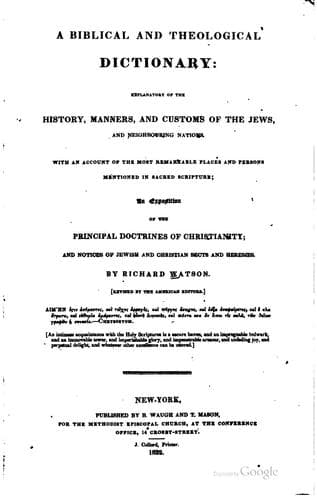
A Biblical and Theological Dictionary: explanatory of the history, manners, and customs of the Jews, and neighbouring nationsWatson, Richard
Religion
A Biblical and Theological Dictionary: explanatory of the history, manners, and customs of the Jews, and neighbouring nations
Watson, Richard
Bible -- Dictionaries; Theology -- Dictionaries
But it is not to be forgotten that this division of animals into clean
and unclean existed both before the law of Moses, and even prior to the
flood. The foundation of it was therefore clearly _sacrificial_; for
before the deluge it could not have reference to health, since animal
food was not allowed to man prior to the deluge; and as no other ground
for the distinction appears, except that of sacrifice, it must therefore
have had reference to the selection of victims to be solemnly offered to
God, as a part of worship, and as the means of drawing near to him by
expiatory rites for the forgiveness of sins. Some it is true, have
regarded this distinction of clean and unclean beasts as used by Moses
by way of _prolepsis_, or anticipation,--a notion which, if it could not
be refuted by the context, would be perfectly arbitrary. Not only are
the beasts, which Noah was to receive, spoken of as clean and unclean;
but it will be noticed, that, in the command to take them into the ark,
a difference is made in the _number_ to be preserved--the _clean_ being
to be received by _sevens_, and the _unclean_ by _two_ of a kind. This
shows that this distinction among beasts had been established in the
time of Noah; and thus the assumption of a prolepsis is refuted. The
critical attempts which have been made to show that animals were allowed
to man for food, previous to the flood, have wholly failed.
A second argument is furnished by the prohibition of blood for food,
after animals had been granted to man for his sustenance along with the
“herb of the field.” This prohibition is repeated by Moses to the
Israelites, with this explanation:--“I have given it upon the altar to
make _an atonement_ for your souls.” From this it has indeed been
argued, that the doctrine of the atoning power of blood was new, and was
then, for the first time, announced by Moses, or the same reason for the
prohibition would have been given to Noah. To this we may reply, 1. That
unless the same be supposed as the ground of the prohibition of blood to
Noah, as that given by Moses to the Jews, no reason at all can be
conceived for this restraint being put upon the appetite of mankind from
Noah to Moses. 2. That it is a mistake to suppose, that the declaration
of Moses to the Jews, that God had “given them the blood for an
atonement,” is an _additional reason_ for the interdict, not to be found
in the original prohibition to Noah. The whole passage in Lev. xvii, is,
“And thou shalt say to them, Whatsoever man there be of the house of
Israel, or of the strangers that sojourn among you, that eateth any
manner of blood, I will even set my face against that soul that eateth
blood, and I will cut him off from among his people: FOR THE LIFE of the
flesh is in the blood; and I have given it upon the altar, to make
atonement for your souls: _for it is the_ BLOOD (or LIFE) that maketh
atonement for the soul.” The great reason, then, of the prohibition of
Public-domain text, read in full here on John Shaqi.
Reviews
Reviews
No reviews yet
Be the first to share your thoughts on this work.
Elsewhere in the archive
Join the Discussion
Join the discussion
Sign in to leave a comment or review.
Sign InorCreate an account