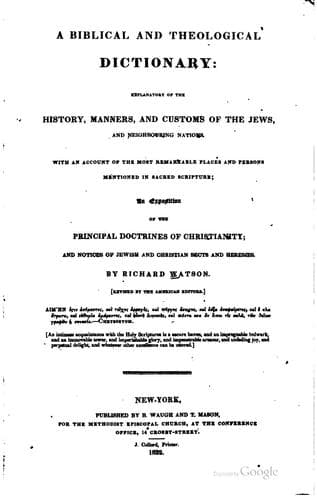
A Biblical and Theological Dictionary: explanatory of the history, manners, and customs of the Jews, and neighbouring nationsWatson, Richard
Religion
A Biblical and Theological Dictionary: explanatory of the history, manners, and customs of the Jews, and neighbouring nations
Watson, Richard
Bible -- Dictionaries; Theology -- Dictionaries
blood is, that it is the LIFE; and what follows respecting atonement is
_exegetical_ of this reason; the life is in the blood, and the blood or
life is given as an atonement. Now, by turning to the original
prohibition in Genesis, we find that precisely the same reason is given:
“But the flesh with the blood, which is _the life_ thereof, shall ye not
eat.” The reason, then, being the same, the question is, whether the
exegesis added by Moses must not necessarily be understood in the
general reason given for the restraint to Noah. Blood is prohibited for
this cause, that it is the _life_; and Moses adds, that it is “the
blood,” _or life_, “which makes atonement.” Let any one attempt to
discover any cause for the prohibition of blood to Noah, in the mere
circumstance that it is “the life,” and he will find it impossible. It
is no reason at all, moral or instituted, except that as it was _life_
substituted for _life_, the life of the animal in sacrifice for the life
of man, and that it had a sacred appropriation. The manner, too, in
which Moses introduces the subject is indicative that, although he was
renewing a prohibition, he was not publishing a “new doctrine;” he does
not teach his people that God had then given, or appointed, blood to
make atonement; but he prohibits them from eating it, because he had
made this appointment, without reference to time, and as a subject with
which they were familiar. Because the blood was the life, it was
sprinkled upon, and poured out at, the altar: and we have in the
sacrifice of the paschal lamb, and the sprinkling of its blood, a
sufficient proof, that, before the giving of the law, not only was blood
not eaten, but was appropriated to a sacred sacrificial purpose. Nor was
this confined to the Jews; it was customary with the Romans and Greeks,
who, in like manner, poured out and sprinkled the blood of victims at
their altars, a rite derived, probably, from the Egyptians, as they
derived it, not from Moses, but from the sons of Noah. The notion,
indeed, that the blood of the victims was peculiarly sacred to the gods,
is impressed upon all ancient Pagan mythology.
If, therefore, the distinction of animals into clean and unclean existed
before the flood, and was founded upon the practice of animal sacrifice,
we have not only a proof of the antiquity of that practice, but that it
was of divine institution and appointment, since almighty God gave laws
for its right and acceptable performance. Still farther, if animal
sacrifice was of divine appointment, it must be concluded to be typical
only, and designed to teach the great doctrine of moral atonement, and
to direct faith to the only true sacrifice which could take away the
sins of men;--“the Lamb slain from the foundation of the world,”--the
victim “without spot,” who suffered the just for the unjust, that he
might bring us to God. See SACRIFICES.
Public-domain text, read in full here on John Shaqi.
Reviews
Reviews
No reviews yet
Be the first to share your thoughts on this work.
Elsewhere in the archive
Join the Discussion
Join the discussion
Sign in to leave a comment or review.
Sign InorCreate an account