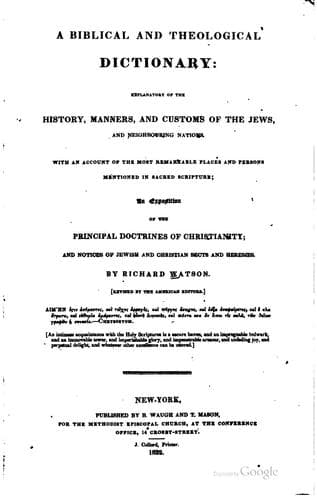
A Biblical and Theological Dictionary: explanatory of the history, manners, and customs of the Jews, and neighbouring nationsWatson, Richard
Religion
A Biblical and Theological Dictionary: explanatory of the history, manners, and customs of the Jews, and neighbouring nations
Watson, Richard
Bible -- Dictionaries; Theology -- Dictionaries
and delude the disciples of Christ, corrupt the doctrine of the
primitive church, enact new laws, and establish its dominion over the
minds of mankind. He then proceeds to show, from the application of
prophecy to history, and to the remarkable train of events that are now
passing in the world, how exactly Popery, Mohammedanism, and Infidelity,
correspond with the character given in Scripture of the power of
antichrist, which was to prevail a certain time for the especial trial
and punishment of the corrupted church of Christ. Upon this system, the
different opinions of the Protestants and Papists, concerning the power
of antichrist, derived from partial views of the subject, are not wholly
incompatible with each other. With respect to the commonly received
opinion, that the church of Rome is antichrist, Mede and Newton, Daubuz
and Clarke, Lowman and Hurd, Jurieu, Vitringa, and many other members of
the Protestant churches who have written upon the subject, concur in
maintaining, that the prophecies of Daniel, St. Paul, and St. John,
point directly to this church. This was likewise the opinion of the
first reformers; and it was the prevalent opinion of Christians, in the
earliest ages, that antichrist would appear soon after the fall of the
Roman empire. Gregory the Great, in the sixth century, applied the
prophecies concerning the beast in the Revelation, the man of sin, and
the apostasy from the faith mentioned by St. Paul, to him who should
presume to claim the title of universal priest, or universal bishop, in
the Christian church; and yet his immediate successor, Boniface III,
received from the tyrant Phocas the precise title which Gregory had thus
censured. At the synod of Rheims, held in the tenth century, Arnulphus,
bishop of Orleans, appealed to the whole council, whether the bishop of
Rome was not the antichrist of St. Paul, “sitting in the temple of God,”
and perfectly corresponding with the description of him given by St.
Paul. In the eleventh century, all the characters of antichrist seemed
to be so united in the person of Pope Hildebrand, who took the name of
Gregory VII, that Johannes Aventinus, a Romish historian, speaks of it
as a subject in which the generality of fair, candid, and ingenuous
writers agreed, that at that time began the reign of antichrist. And the
Albigenses and Waldenses, who may be called the Protestants of the
twelfth and thirteenth centuries, expressly asserted in their
declarations of faith, that the church of Rome was the whore of Babylon.
The Papists imagine they view in the prophetical picture of antichrist,
imperial Rome, elated by her victories, exulting in her sensuality and
her spoils, polluted by idolatry, persecuting the people of God, and
finally falling like the first Babylon; whilst a new and holy city,
represented by their own communion, filled with the spotless votaries of
the Christian faith, rises out of its ruins, and the victory of the
cross is completed over the temples of Paganism.
Public-domain text, read in full here on John Shaqi.
Reviews
Reviews
No reviews yet
Be the first to share your thoughts on this work.
Elsewhere in the archive
Join the Discussion
Join the discussion
Sign in to leave a comment or review.
Sign InorCreate an account