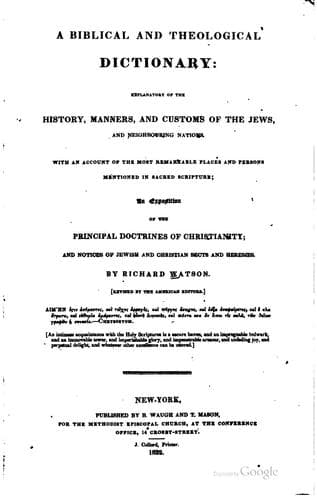
A Biblical and Theological Dictionary: explanatory of the history, manners, and customs of the Jews, and neighbouring nationsWatson, Richard
Religion
A Biblical and Theological Dictionary: explanatory of the history, manners, and customs of the Jews, and neighbouring nations
Watson, Richard
Bible -- Dictionaries; Theology -- Dictionaries
This revelation was necessarily antecedent to the faith; but it is also
to be observed, that the acts by which the faith was represented,
whenever it was represented by particular acts, and when the case
admitted it, had a natural and striking conformity and correspondence to
the previous revelation. So Noah built the ark, which indicated that he
had heard the threat of the world’s destruction by water, and had
received the promise of his own preservation, and that of his family, as
well as that of a part of the beasts of the earth. When Abraham went
into Canaan at the command of God, and upon the promise that that
country should become the inheritance of his decendants, he showed his
faith by taking possession of it for them in anticipation, and his
residence there indicated the kind of promise which he had received.
Thus these instances show, that when the faith which the Apostle
commends exhibited itself in some particular act, that act had a
correspondency to the previous promise or revelation which was the
ground of faith. We must therefore interpret the acts of Abel’s faith so
as to make them also correspond with an antecedent revelation. His faith
had respect to some previous revelation, and the nature of the
revelation is to be collected from the significant manner in which he
declared his faith in it.
Now that which Abel did “by faith,” was, _generally_, to perform an act
of solemn worship, in the confidence that it would be acceptable to God.
This supposes a revelation, immediate or by tradition, that such acts of
worship were acceptable to God, or his faith could have had no warrant,
and would not have been faith, but fancy. But the case must be
considered more particularly. His faith led him to offer “a more
excellent sacrifice” than that of Cain; but this as necessarily implies,
that there was some antecedent revelation to which his faith, as thus
expressed, had respect, and on which that peculiarity of his offering,
which distinguished it from the offering of Cain, was founded; a
revelation which indicated that the way in which God would be approached
acceptably, in solemn worship, was by animal sacrifices. Without this,
the faith to which his offering, which was an offering of the firstlings
of his flock, had a special fitness and adaptation, could have had no
warrant in Divine authority. But this revelation must have included, in
order to its being the ground of faith, as “the substance of things
hoped for,” a promise of a benefit to be conferred, in which promise
Abel might _confide_. But if so, then this promise must have been
connected, not with the worship of God in general, or performed in any
way whatever indifferently, but with his worship by animal oblations;
for it was in this way that the faith of Abel specially and
distinctively indicated itself. The antecedent revelation was,
therefore, a promise of a benefit to be conferred, by means of animal
sacrifice; and we are taught what this benefit was, by that which was
Public-domain text, read in full here on John Shaqi.
Reviews
Reviews
No reviews yet
Be the first to share your thoughts on this work.
Join the Discussion
Join the discussion
Sign in to leave a comment or review.
Sign InorCreate an account