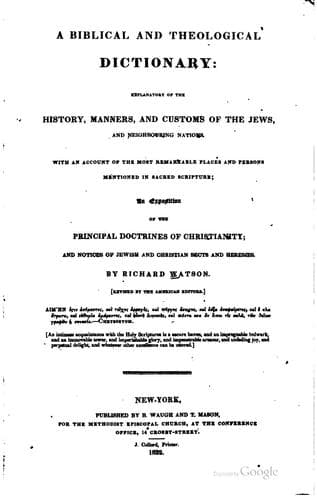
A Biblical and Theological Dictionary: explanatory of the history, manners, and customs of the Jews, and neighbouring nationsWatson, Richard
Religion
A Biblical and Theological Dictionary: explanatory of the history, manners, and customs of the Jews, and neighbouring nations
Watson, Richard
Bible -- Dictionaries; Theology -- Dictionaries
actually received by the offerer,--“He obtained witness that he was
_righteous_;” which must be interpreted in the sense of a declaration of
his personal justification, and acceptance as righteous, by the
forgiveness of his sins. The reason of Abel’s acceptance and of Cain’s
rejection is hereby made manifest; the one, in seeking the Divine
favour, conformed to his established and appointed method of being
approached by guilty men, and the other not only neglected this, but
profanely and presumptuously substituted his own inventions.
5. It is impossible, then, to allow the sacrifice of Abel, in this
instance, to have been an act of FAITH, without supposing that it had
respect to a previous revelation, which agreed with all the parts of
that sacrificial action by which he expressed his faith in it. Had
Abel’s sacrifice been eucharistic merely, it would have expressed
gratitude, but not faith; or if faith in the general sense of confidence
in God that he would receive an act of grateful worship, and reward the
worshippers, it did not more express faith than the offering of Cain,
who surely believed these two points, or he would not have brought an
offering of any kind. The offering of Abel expressed a faith which Cain
had not; and the doctrinal principles which Abel’s faith respected were
such as his sacrifice visibly embodied. If it was not an eucharistic
sacrifice, it was an expiatory one; and, in fact, it is only in a
sacrifice of this kind, that it is possible to see that faith exhibited
which Abel had, and Cain had not. If then we refer to the subsequent
sacrifices of expiation appointed by Divine authority, and their
explanation in the New Testament, it will be obvious to what doctrines
and principles of an antecedent revelation the faith of Abel had
respect, and which his sacrifice, the exhibition of his faith,
proclaimed: confession of the fact of being a sinner,--acknowledgment
that the demerit and penalty of sin is death,--submission to an
appointed mode of expiation,--animal sacrifice offered _vicariously_,
but in itself a mere type of a better sacrifice, “the Seed of the
woman,” appointed to be offered at some future period,--and the efficacy
of this appointed method of expiation to obtain forgiveness, and to
admit the guilty into the Divine favour.
Public-domain text, read in full here on John Shaqi.
Reviews
Reviews
No reviews yet
Be the first to share your thoughts on this work.
Join the Discussion
Join the discussion
Sign in to leave a comment or review.
Sign InorCreate an account