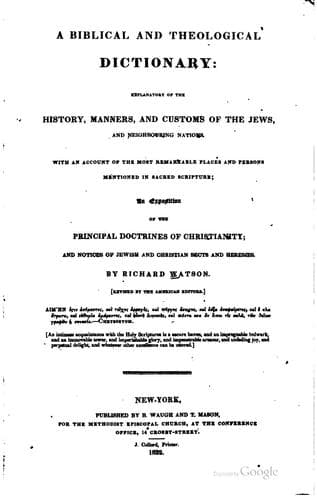
A Biblical and Theological Dictionary: explanatory of the history, manners, and customs of the Jews, and neighbouring nationsWatson, Richard
Religion
A Biblical and Theological Dictionary: explanatory of the history, manners, and customs of the Jews, and neighbouring nations
Watson, Richard
Bible -- Dictionaries; Theology -- Dictionaries
This scheme has had its
able advocates, at the head of whom may be placed Bossuet, bishop of
Meaux, Grotius, and Hammond. Some writers have maintained, that Caligula
was antichrist; and others have asserted the same of Nero. But in order
to establish the resemblance, they violate the order of time, disregard
the opinions of the primitive Christians, and overlook the appropriate
descriptions of the Apostles. After the point had been maturely debated
at the council of Gap, held in 1603, a resolution was taken thereupon to
insert an article in the confession of faith, whereby the Pope is
formally declared to be antichrist. Pope Clement VIII was stung with
this decision; and even king Henry IV, of France was not a little
mortified, to be thus declared, as he said, an imp of antichrist.
In the book of Daniel it is foretold, that this power should exercise
dominion until a time and times, and the dividing of time, Dan. vii, 25.
This expression is generally admitted to denote 1260 years. The Papal
power was completely established in the year 755, when it obtained the
exarchate of Ravenna. Some, however, date the rise of antichrist in the
year of Christ 606; and Mede places it in 456. If the rise of antichrist
be not reckoned till he was possessed of secular authority, his fall
will happen when this power shall be taken away. If his rise began,
according to Mede in 456, he must have fallen in 1716; if in 606, it
must be in 1866; if in 755, in 2015. If, however, we use prophetical
years, consisting of three hundred and sixty days, and date the rise of
antichrist in the year 755, his fall will happen in the year of Christ
2000. Every thing however in the state of the world betokens a speedy
overthrow of the Papal and Mohammedan powers, both of which have indeed
been already greatly weakened.
ANTI-LIBANUS. The Greeks give this name to that chain of mountains east
of Libanus, which, properly speaking, forms, together with Libanus, but
one ridge of mountains, extending from north to south, and afterward
from south to north, in the shape almost of a horse shoe, for the space
of about fourscore leagues. The western part of these mountains was
called Libanus; the eastern was called Antilibanus; the former reached
along the Mediterranean, from Sidon, almost to Arada, or Symira. The
Hebrew text never mentions Antilibanus; but uses the general name
Libanus: and the coins struck at Laodicea and Hierapolis, have the
inscription, “cities of Libanus,” though they belong rather to
Antilibanus. The Septuagint, on the contrary, puts Antilibanus often
instead of Libanus. The valley which separates Libanus from Antilibanus
is very fruitful: it was formerly, on the side of Syria, inclosed with a
wall, whereof there are now no traces. Strabo says, that the name of
Cœlo-Syria, or “the hollow Syria,” belongs principally to the valley
between Libanus and Antilibanus.
Public-domain text, read in full here on John Shaqi.
Reviews
Reviews
No reviews yet
Be the first to share your thoughts on this work.
Elsewhere in the archive
Join the Discussion
Join the discussion
Sign in to leave a comment or review.
Sign InorCreate an account