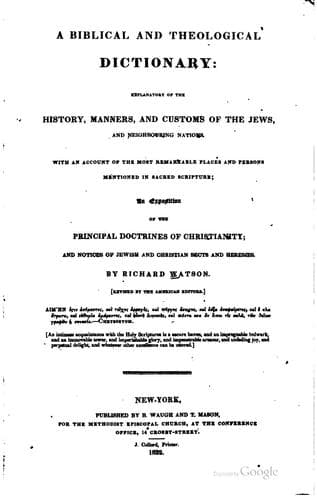
A Biblical and Theological Dictionary: explanatory of the history, manners, and customs of the Jews, and neighbouring nationsWatson, Richard
Religion
A Biblical and Theological Dictionary: explanatory of the history, manners, and customs of the Jews, and neighbouring nations
Watson, Richard
Bible -- Dictionaries; Theology -- Dictionaries
ANTINOMIANS are those who maintain that the law is of no use or
obligation under the Gospel dispensation, or who hold doctrines that
clearly supersede the necessity of good works and a virtuous life. The
Antinomians took their origin from John Agricola, about the year 1538,
who taught that the law was in no wise necessary under the Gospel; that
good works do not promote our salvation, nor ill ones hinder it; that
repentance is not to be preached from the decalogue, but only from the
Gospel. This sect sprung up in England during the protectorate of Oliver
Cromwell; and extended their system of libertinism much farther than
Agricola, the disciple of Luther. Some of their teachers expressly
maintained, that as the elect cannot fall from grace nor forfeit the
divine favour, the wicked actions they commit are not really sinful, nor
are to be considered as instances of their violation of the divine law;
and that consequently they have no occasion either to confess their
sins, or to break them off by repentance. According to them, it is one
of the essential and distinctive characters of the elect, that they
cannot do any thing which is displeasing to God. Luther, Rutherford,
Schlusselburgh, Sedgwick, Gataker, Witsius, Bull, Williams, &c, have
written refutations; Crisp, Richardson, Saltmarsh, &c, defences, of the
Antinomians; Wigandus, a comparison between ancient and modern
Antinomians.
The doctrine of Agricola was in itself obscure, and is thought to have
been represented worse than it really was by Luther, who wrote against
him with acrimony, and first styled him and his followers Antinomians.
Agricola, in defending himself, complained that opinions were imputed to
him which he did not hold. The writings of Dr. Crisp in the seventeenth
century are considered as highly favourable to Antinomianism, though he
acknowledges that, “in respect of the rules of righteousness, or the
matter of obedience, we are under the law still, or else,” as he adds,
“we are lawless, to live every man as seems good in his own eyes, which
no true Christian dares so much as think of.” The following sentiments,
however, among others, are taught in his sermons: “The law is cruel and
tyrannical, requiring what is naturally impossible.” “The sins of the
elect were so imputed to Christ, as that though he did not commit them,
yet they became actually his transgressions, and ceased to be theirs.”
“The feelings of conscience, which tell them that sin is theirs, arise
from a want of knowing the truth.” “It is but the voice of a lying
spirit in the hearts of believers, that saith they have yet sin wasting
their consciences, and lying as a burden too heavy for them to bear.”
“Christ’s righteousness is so imputed to the elect, that they, ceasing
to be sinners, are as righteous as he was, and all that he was.” “An
elect person is not in a condemned state while an unbeliever; and should
he happen to die before God call him to believe, he would not be lost.”
Public-domain text, read in full here on John Shaqi.
Reviews
Reviews
No reviews yet
Be the first to share your thoughts on this work.
Elsewhere in the archive
Join the Discussion
Join the discussion
Sign in to leave a comment or review.
Sign InorCreate an account