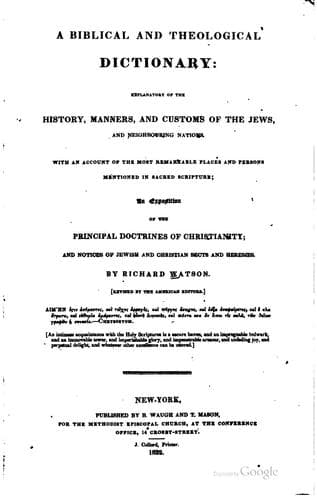
A Biblical and Theological Dictionary: explanatory of the history, manners, and customs of the Jews, and neighbouring nationsWatson, Richard
Religion
A Biblical and Theological Dictionary: explanatory of the history, manners, and customs of the Jews, and neighbouring nations
Watson, Richard
Bible -- Dictionaries; Theology -- Dictionaries
“Repentance and confession of sin are not necessary to forgiveness. A
believer may certainly conclude before confession, yea, as soon as he
hath committed sin, the interest he hath in Christ, and the love of
Christ embracing him.” These dangerous sentiments, and others of a
similar bearing, have been fully answered by many writers; but by none
more ably than by the Rev. John Fletcher, in his “Checks to
Antinomianism.”
ANTIOCH, a city of Upper Syria, on the river Orontes, about twenty miles
from the place where it discharges itself into the Mediterranean. It was
built by Seleucus Nicanor, about three hundred years before Christ; and
became the seat of empire of the Syrian kings of the Macedonian race,
and afterward of the Roman governors of the eastern provinces; being
very centrally and commodiously situated midway between Constantinople
and Alexandria, about seven hundred miles from each, in 37° 17´ north
latitude, and 36° 45´ east longitude. No city perhaps, Jerusalem
excepted, has experienced more frequent revolutions, or suffered more
numerous and dire calamities, than Antioch; as, besides the common
plagues of eastern cities, pestilence, famine, fire, and sword, it has
several times been entirely overthrown by earthquakes.
In 362, the emperor Julian spent some months at Antioch; which were
chiefly occupied in his favourite object of reviving the mythology of
Paganism. The grove at Daphne, planted by Seleucus, which, with its
temple and oracle, presented, during the reigns of the Macedonian kings
of Syria, the most splendid and fashionable place of resort for Pagan
worship in the east, had sunk into neglect since the establishment of
Christianity. The altar of the god was deserted, the oracle was
silenced, and the sacred grove itself defiled by the interment of
Christians. Julian undertook to restore the ancient honours and usages
of the place; but it was first necessary to take away the pollution
occasioned by the dead bodies of the Christians, which were disinterred
and removed! Among these was that of Babylas, a bishop of Antioch, who
died in prison in the persecution of Decius, and after resting near a
century in his grave within the walls of Antioch, had been removed by
order of Gallus into the midst of the grove of Daphne, where a church
was built over him; the remains of the Christian saint effectually
supplanting the former divinity of the place, whose temple and statue,
however, though neglected, remained uninjured. The Christians of
Antioch, undaunted by the conspiracy against their religion, or the
presence of the emperor himself, conveyed the relics of their former
bishop in triumph back to their ancient repository within the city. The
immense multitude who joined in the procession, chanted forth their
execrations against idols and idolaters; and on the same night the image
and the temple of the Heathen god were consumed by the flames. A
dreadful vengeance might be expected to have followed these scenes; but
Public-domain text, read in full here on John Shaqi.
Reviews
Reviews
No reviews yet
Be the first to share your thoughts on this work.
Elsewhere in the archive
Join the Discussion
Join the discussion
Sign in to leave a comment or review.
Sign InorCreate an account