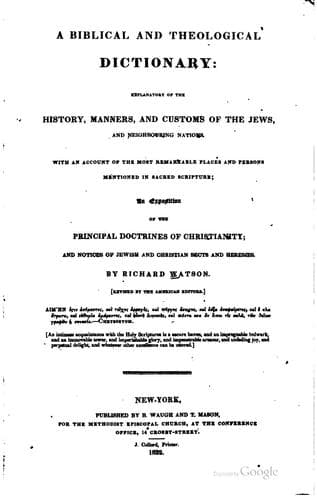
A Biblical and Theological Dictionary: explanatory of the history, manners, and customs of the Jews, and neighbouring nationsWatson, Richard
Religion
A Biblical and Theological Dictionary: explanatory of the history, manners, and customs of the Jews, and neighbouring nations
Watson, Richard
Bible -- Dictionaries; Theology -- Dictionaries
the real or affected clemency of Julian contented itself with shutting
up the cathedral, and confiscating its wealth. Many Christians, indeed,
suffered from the zeal of the Pagans; but, as it would appear, without
the sanction of the emperor.
In 1268, Antioch was taken by Bibars, or Bondocdar, sultan of Egypt. The
slaughter of seventeen thousand, and the captivity of one hundred
thousand of its inhabitants, mark the final siege and fall of Antioch;
which, while they close the long catalogue of its public woes, attest
its extent and population. From this time it remained in a ruinous and
nearly deserted condition, till, with the rest of Syria, it passed into
the hands of the Ottoman Turks, with whose empire it has ever since been
incorporated.
To distinguish it from other cities of the same name, the capital of
Syria was called _Antiochia apud Daphnem_, or Antioch near Daphne, a
village in the neighbourhood, where was a temple dedicated to the
goddess of that name; though, in truth, the chief deity of the place was
Apollo, under the fable of his amorous pursuit of the nymph Daphne; and
the worship was worthy of its object. The temple stood in the midst of a
grove of laurels and cypresses, where every thing was assembled which
could minister to the senses; and in whose recesses the juvenile devotee
wanted not the countenance of a libertine god to abandon himself to
voluptuousness. Even those of riper years and graver morals could not
with safety breathe the atmosphere of a place where pleasure, assuming
the character of religion, roused the dormant passions, and subdued the
firmness of virtuous resolution. Such being the source, the stream could
scarcely be expected to be more pure; in fact, the citizens of Antioch
were distinguished only for their luxury in life and licentiousness in
manners. This was an unpromising soil for Christianity to take root in.
But here, nevertheless, it was planted at an early period, and
flourished vigorously. It should be observed, that the inhabitants of
Antioch were partly Syrians, and partly Greeks; chiefly, perhaps, the
latter, who were invited to the new city by Seleucus. To these Greeks,
in particular, certain Cypriot and Cyrenian converts, who had fled from
the persecution which followed the death of Stephen, addressed
themselves; “and a great number believed, and turned unto the Lord.”
When the heads of the church at Jerusalem were informed of this success,
they sent Barnabas to Antioch, who encouraged the new disciples, and
added many to their number; and finding how great were both the field
and the harvest, went to Tarsus to solicit the assistance of Paul. Both
this Apostle and Barnabas then taught conjointly at Antioch; and great
numbers were, by their labours during a whole year, added to the rising
church, Acts xi, 19–26; xv, 22–35. Here they were also joined by Peter,
who was reproved by Paul for his dissimulation, and his concession to
the Jews respecting the observance of the law, Gal. ii, 11–14.
Public-domain text, read in full here on John Shaqi.
Reviews
Reviews
No reviews yet
Be the first to share your thoughts on this work.
Elsewhere in the archive
Join the Discussion
Join the discussion
Sign in to leave a comment or review.
Sign InorCreate an account