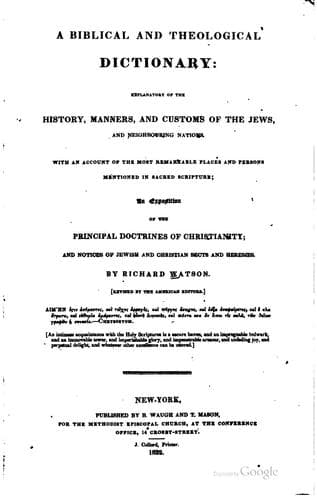
A Biblical and Theological Dictionary: explanatory of the history, manners, and customs of the Jews, and neighbouring nationsWatson, Richard
Religion
A Biblical and Theological Dictionary: explanatory of the history, manners, and customs of the Jews, and neighbouring nations
Watson, Richard
Bible -- Dictionaries; Theology -- Dictionaries
Antioch was the birthplace of St. Luke and Theophilus, and the see of
the martyr Ignatius. In this city the followers of Christ had first the
name of Christians given them. We have the testimony of Chrysostom, both
of the vast increase of this illustrious church in the fourth century,
and of the spirit of charity which continued to actuate it. It consisted
at this time of not less than a hundred thousand persons, three thousand
of whom were supported out of the public donations. It is painful to
trace the progress of declension in such a church as this. But the
period now referred to, namely, the age of Chrysostom, toward the close
of the fourth century, may be considered as the brightest of its history
subsequent to the Apostolic age, and that from which the church at
Antioch may date its fall. It continued, indeed, outwardly prosperous;
but superstition, secular ambition, the pride of life; pomp and
formality in the service of God, in place of humility and sincere
devotion; the growth of faction, and the decay of charity; showed that
real religion was fast disappearing, and that the foundations were laid
of that great apostasy which, in two centuries from this time,
overspread the whole Christian world, led to the entire extinction of
the church in the east, and still holds dominion over the fairest
portions of the west.
Antioch, under its modern name of Antakia, is now but little known to
the western nations. It occupies, or rather did till lately occupy, a
remote corner of the ancient enclosure of its walls. Its splendid
buildings were reduced to hovels; and its population of half a million,
to ten thousand wretched beings, living in the usual debasement and
insecurity of Turkish subjects. Such was nearly its condition when
visited by Pocock about the year 1738, and again by Kinneir in 1813. But
its ancient subterranean enemy, which, since its destruction in 587,
never long together withheld its assaults, has again triumphed over it:
the earthquake of the 13th of August, 1822, laid it once more in ruins;
and every thing relating to Antioch is past.
ANTIOCH, of Pisidia. Beside the Syrian capital, there was another
Antioch visited by St. Paul when in Asia, and called, for the sake of
distinction, _Antiochia ad Pisidiam_, as belonging to that province, of
which it was the capital. Here Paul and Barnabas preached; but the Jews,
jealous, as usual, of the reception of the Gospel by the Gentiles,
raised a sedition against them, and obliged them to leave the city, Acts
xiii, 14, to the end. There were several other cities of the same name,
sixteen in number, in Syria and Asia Minor, built by the Seleucidæ, the
successors of Alexander in these countries; but the above two are the
only ones which it is necessary to describe as occurring in Scripture.
Public-domain text, read in full here on John Shaqi.
Reviews
Reviews
No reviews yet
Be the first to share your thoughts on this work.
Elsewhere in the archive
Join the Discussion
Join the discussion
Sign in to leave a comment or review.
Sign InorCreate an account