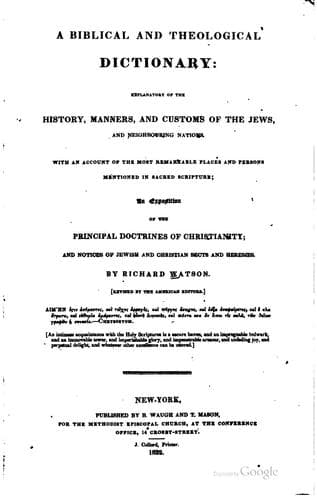
A Biblical and Theological Dictionary: explanatory of the history, manners, and customs of the Jews, and neighbouring nationsWatson, Richard
Religion
A Biblical and Theological Dictionary: explanatory of the history, manners, and customs of the Jews, and neighbouring nations
Watson, Richard
Bible -- Dictionaries; Theology -- Dictionaries
ANTIOCHUS. There were many kings of this name in Syria, much celebrated
in the Greek, Roman, and Jewish histories, after the time of Seleucus
Nicanor, the father of Antiochus Soter, and reckoned the first king of
Syria, after Alexander the Great.
1. ANTIOCHUS SOTER was the son of Seleucus Nicanor, and obtained the
surname of Soter, or Saviour, from having hindered the invasion of Asia
by the Gauls. Some think that it was on the following occasion: The
Galatians having marched to attack the Jews in Babylon, whose army
consisted only of eight thousand men, reinforced with four thousand
Macedonians, the Jews defended themselves with so much bravery, that
they killed one hundred and twenty thousand men, 2 Mac. viii, 20. It was
perhaps, too, on this occasion, that Antiochus Soter made the Jews of
Asia free of the cities belonging to the Gentiles, and permitted them to
live according to their own laws.
2. ANTIOCHUS THEOS, or, the God, was the son and successor of Antiochus
Soter. He married Berenice, daughter of Ptolemy Philadelphus, king of
Egypt. Laodice, his first wife, seeing herself despised, poisoned
Antiochus, Berenice, and their son, who was intended to succeed in the
kingdom. After this, Laodice procured Seleucus Callinicus, her son by
Antiochus, to be acknowledged king of Syria. These events were foretold
by Daniel: “And in the end of years,” the king of Egypt, or of the
south, and the king of Syria, or of the north, “shall join themselves
together; for the king’s daughter of the south shall come to the king of
the north to make an agreement: but she shall not retain the power of
the arm; neither shall he stand, nor his arm: but she shall be given up,
and they that brought her, and he that begat her, and he that
strengthened her in these times,” Dan. xi, 6.
Public-domain text, read in full here on John Shaqi.
Reviews
Reviews
No reviews yet
Be the first to share your thoughts on this work.
Elsewhere in the archive
Join the Discussion
Join the discussion
Sign in to leave a comment or review.
Sign InorCreate an account