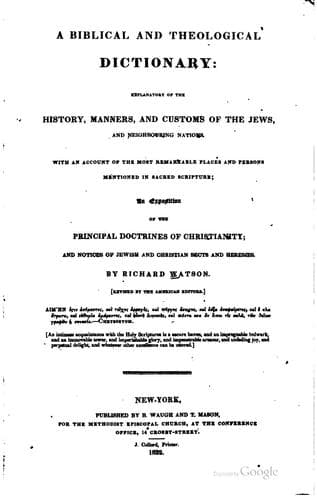
A Biblical and Theological Dictionary: explanatory of the history, manners, and customs of the Jews, and neighbouring nationsWatson, Richard
Religion
A Biblical and Theological Dictionary: explanatory of the history, manners, and customs of the Jews, and neighbouring nations
Watson, Richard
Bible -- Dictionaries; Theology -- Dictionaries
3. ANTIOCHUS THE GREAT was the son of Seleucus Callinicus, and brother
to Seleucus Ceraunus, whom he succeeded in the year of the world 3781,
and before Jesus Christ 223. He made war against Ptolemy Philopator,
king of Egypt, but was defeated near Raphia, 3 Mac. i. Thirteen years
after, Ptolemy Philopator being dead, Antiochus resolved to become
master of Egypt. He immediately seized Cœlo-Syria, Phenicia, and
Judea; but Scopas, general of the Egyptian army, entered Judea while
Antiochus was occupied by the war against Attalus, and retook those
places. However, he soon lost them again to Antiochus. On this occasion
happened what Josephus relates of this prince’s journey to Jerusalem.
After a victory which he had obtained over Scopas, near the springs of
Jordan, he became master of the strong places in Cœlo-Syria and
Samaria; and the Jews submitted freely to him, received him into their
city and furnished his army plentifully with provisions. In reward for
their affection, Antiochus granted them, according to Josephus, twenty
thousand pieces of silver, to purchase beasts for sacrifice, one
thousand four hundred and sixty measures of meal, and three hundred and
seventy-five measures of salt to be offered with the sacrifices, and
timber to rebuild the porches of the Lord’s house. He exempted the
senators, scribes, and singing men of the temple, from the capitation
tax; and he permitted the Jews to live according to their own laws in
every part of his dominions. He also remitted the third part of their
tribute, to indemnify them for their losses in the war; he forbade the
Heathens to enter the temple without being purified, and to bring into
the city the flesh of mules, asses, and horses to sell, under a severe
penalty.
In the year of the world 3815, Antiochus was overcome by the Romans, and
obliged to cede all his possessions beyond Mount Taurus, to give twenty
hostages, among whom was his own son Antiochus, afterward surnamed
Epiphanes, and to pay a tribute of twelve thousand Euboic talents, each
fourteen Roman pounds in weight. To defray these charges, he resolved to
seize the treasures of the temple of Belus, at Elymais; but the people
of that country, informed of his design, surprised and destroyed him,
with all his army, in the year of the world 3817, and before Jesus
Christ 187. He left two sons, Seleucus Philopator, and Antiochus
Epiphanes, who succeeded him.
Public-domain text, read in full here on John Shaqi.
Reviews
Reviews
No reviews yet
Be the first to share your thoughts on this work.
Elsewhere in the archive
Join the Discussion
Join the discussion
Sign in to leave a comment or review.
Sign InorCreate an account