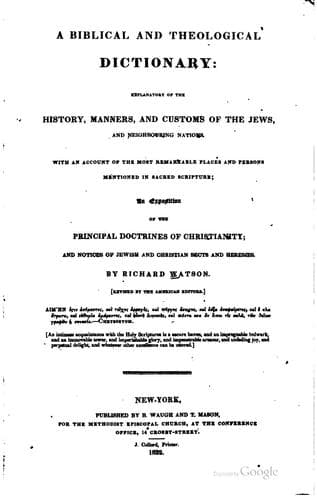
A Biblical and Theological Dictionary: explanatory of the history, manners, and customs of the Jews, and neighbouring nationsWatson, Richard
Religion
A Biblical and Theological Dictionary: explanatory of the history, manners, and customs of the Jews, and neighbouring nations
Watson, Richard
Bible -- Dictionaries; Theology -- Dictionaries
4. ANTIOCHUS EPIPHANES, the son of Antiochus the Great, having continued
a hostage at Rome fourteen years, his brother Seleucus resolved to
procure his return to Syria, and sent his own son Demetrius to Rome in
the place of Antiochus. Whilst Antiochus was on his journey to Syria,
Seleucus died, in the year of the world 3829. When, therefore, Antiochus
landed, the people received him as some propitious deity come to assume
the government, and to oppose the enterprises of Ptolemy, king of Egypt,
who threatened to invade Syria. For this reason Antiochus obtained the
surname of Epiphanes, the illustrious, or of one appearing like a god.
Antiochus quickly turned his attention to the possession of Egypt, which
was then enjoyed by Ptolemy Philometor, his nephew, son to his sister
Cleopatra, whom Antiochus the Great had married to Ptolemy Epiphanes,
king of Egypt. He sent Apollonius, one of his officers, into Egypt,
apparently to honour Ptolemy’s coronation, but in reality to obtain
intelligence whether the great men of the kingdom were inclined to place
the government of Egypt in his hands during the minority of the king his
nephew, 2 Mac. iv, 21, &c. Apollonius, however, found them not disposed
to favour his master; and this obliged Antiochus to make war against
Philometor. He came to Jerusalem in 3831, and was received there by
Jason, to whom he had sold the high priesthood. He designed to attack
Egypt, but returned without effecting any thing. The ambition of those
Jews who sought the high priesthood, and bought it of Antiochus, was the
beginning of those calamities which overwhelmed their nation under this
prince. Jason procured himself to be constituted in this dignity in the
stead of Onias III; but Menelaus offering a greater price, Jason was
deprived, and Menelaus appointed in his place. These usurpers of the
high priesthood, to gratify the Syrians, assumed the manners of the
Greeks, their games and exercises, and neglected the worship of the
Lord, and the temple service.
Public-domain text, read in full here on John Shaqi.
Reviews
Reviews
No reviews yet
Be the first to share your thoughts on this work.
Elsewhere in the archive
Join the Discussion
Join the discussion
Sign in to leave a comment or review.
Sign InorCreate an account