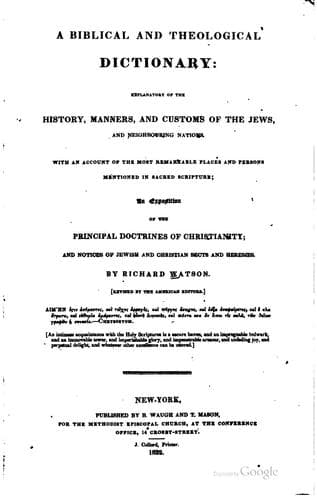
A Biblical and Theological Dictionary: explanatory of the history, manners, and customs of the Jews, and neighbouring nationsWatson, Richard
Religion
A Biblical and Theological Dictionary: explanatory of the history, manners, and customs of the Jews, and neighbouring nations
Watson, Richard
Bible -- Dictionaries; Theology -- Dictionaries
War broke out between Antiochus Epiphanes and Ptolemy Philometor.
Antiochus entered Egypt in the year of the world 3833, and reduced
almost the whole of it to his obedience, 2 Mac. v, 3–5. The next year he
returned; and whilst he was engaged in the siege of Alexandria, a false
report was spread of his death. The inhabitants of Jerusalem testifying
their joy at this news, Antiochus, when returning from Egypt, entered
this city by force, treated the Jews as rebels, and commanded his troops
to slay all they met. Eighty thousand were killed, made captives, or
sold on this occasion. Antiochus, conducted by the corrupt high priest
Menelaus, entered into the holy of holies, whence he took and carried
off the most precious vessels of that holy place, to the value of one
thousand eight hundred talents. In the year 3835, Antiochus made a third
expedition against Egypt, which he entirely subdued. The year following,
he sent Apollonius into Judea, with an army of twenty-two thousand men,
and commanded him to kill all the Jews who were of full age, and to sell
the women and young men, 2 Mac. v, 24, 25. These orders were too
punctually executed. It was on this occasion that Judas Maccabæus
retired into the wilderness with his father and his brethren, 2 Mac. v,
29. These misfortunes were only preludes of what they were to suffer;
for Antiochus, apprehending that the Jews would never be constant in
their obedience to him, unless he obliged them to change their religion,
and to embrace that of the Greeks, issued an edict, enjoining them to
conform to the laws of other nations, and forbidding their usual
sacrifices in the temple, their festivals, and their Sabbath. The statue
of Jupiter Olympus was placed upon the altar of the temple, and thus the
abomination of desolation was seen in the temple of God. Many corrupt
Jews complied with these orders; but others resisted them. Mattathias
and his sons retired to the mountains. Old Eleazar, and the seven
brethren, suffered death with great courage at Antioch, 2 Mac. vii.
Mattathias being dead, Judas Maccabæus headed those Jews who continued
faithful, and opposed with success the generals whom king Antiochus sent
into Judea. The king, informed of the valour and resistance of Judas,
sent new forces; and, finding his treasures exhausted, he resolved to go
into Persia to levy tributes, and to collect large sums which he had
agreed to pay to the Romans, 1 Mac. iii, 5–31; 2 Mac. ix, 1, &c; 1 Mac.
vi, 1, &c. Knowing that very great riches were lodged in the temple of
Elymaïs, he determined to carry it off; but the inhabitants of the
country made so vigorous a resistance, that he was forced to retreat
toward Babylonia. When he was come to Ecbatana, he was informed of the
defeat of Nicanor and Timotheus, and that Judas Maccabæus had retaken
the temple of Jerusalem, and restored the worship of the Lord, and the
usual sacrifices. On receiving this intelligence, the king was
Public-domain text, read in full here on John Shaqi.
Reviews
Reviews
No reviews yet
Be the first to share your thoughts on this work.
Elsewhere in the archive
Join the Discussion
Join the discussion
Sign in to leave a comment or review.
Sign InorCreate an account