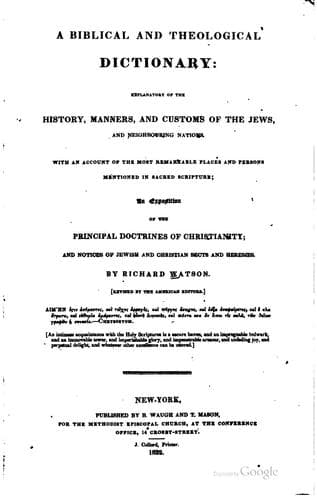
A Biblical and Theological Dictionary: explanatory of the history, manners, and customs of the Jews, and neighbouring nationsWatson, Richard
Religion
A Biblical and Theological Dictionary: explanatory of the history, manners, and customs of the Jews, and neighbouring nations
Watson, Richard
Bible -- Dictionaries; Theology -- Dictionaries
APOCALYPSE, Ἀποκάλυψις, signifies _revelation_. It is, however,
particularly applied to the Revelations which St. John had in the isle
of Patmos, whither he had been banished. The testimonies in favour of
the book of the Revelation being a genuine work of St. John the
Evangelist are very full and satisfactory. Andrew, bishop of Cæsarea in
Capadocia, in the fifth century, assures us that Papias acknowledged the
Revelation to be inspired. But the earliest author now extant who
mentions this book is Justin Martyr, who lived about sixty years after
it was written, and he ascribes it to St. John. So does Iræneus, whose
evidence is alone sufficient upon this point; for he was the disciple of
Polycarp, who was the disciple of John himself; and he expressly tells
us that he had the explanation of a certain passage in this book from
those who had conversed with St. John the author. These two fathers are
followed by Clement of Alexandria, Theophilus of Antioch, Tertullian,
Origen, Cyprian, Lactantius, Jerome, Athanasius, and many other
ecclesiastical writers, all of whom concur in considering the Apostle
John as the author of the Revelation. Some few persons, however, doubted
the genuineness of this book in the third and fourth centuries; but
since that time it has been very generally acknowledged to be canonical;
and, indeed, as Mr. Lowman observes, “hardly any one book has received
more early, more authentic, and more satisfactory attestations.” The
omission of this book in some of the early catalogues of the Scriptures,
was probably not owing to any suspicion concerning its authenticity or
genuineness, but because its obscurity and mysteriousness were thought
to render it less fit to be read publicly and generally. It is called
the Revelation of John the Divine; and this appellation was first given
to St. John by Eusebius, not to distinguish him from any other person of
the same name, but as an honourable title, intimating that to him was
more fully revealed the system of divine counsels than to any other
prophet of the Christian dispensation.
St. John was banished to Patmos in the latter part of the reign of
Domitian, and he returned to Ephesus immediately after the death of that
emperor, which happened in the year 96; and as the Apostle states, that
these visions appeared to him while he was in that island, we may
consider this book as written in the year 95 or 96.
Public-domain text, read in full here on John Shaqi.
Reviews
Reviews
No reviews yet
Be the first to share your thoughts on this work.
Elsewhere in the archive
Join the Discussion
Join the discussion
Sign in to leave a comment or review.
Sign InorCreate an account