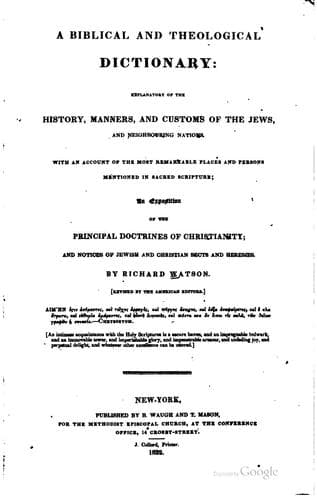
A Biblical and Theological Dictionary: explanatory of the history, manners, and customs of the Jews, and neighbouring nationsWatson, Richard
Religion
A Biblical and Theological Dictionary: explanatory of the history, manners, and customs of the Jews, and neighbouring nations
Watson, Richard
Bible -- Dictionaries; Theology -- Dictionaries
In the first chapter, St. John asserts the divine authority of the
predictions which he is about to deliver; addresses himself to the
churches of the Proconsular Asia; and describes the first vision, in
which he is commanded to write the things then revealed to him. The
second and third chapters contain seven epistles to the seven churches
in Asia; namely, of Ephesus, Smyrna, Pergamus, Thyatira, Sardis,
Philadelphia, and Laodicea, which relate chiefly to their then
respective circumstances and situation. At the fourth chapter the
prophetic visions begin, and reach to the end of the book. They contain
a prediction of all the most remarkable revolutions and events in the
Christian church from the time of the Apostle to the final consummation
of all things. An attempt to explain these prophecies does not fall
within the design of this work; and therefore those who are disposed to
study this sublime and mysterious book are referred to Mede, Daubuz, Sir
Isaac Newton, Lowman, Bishop Newton, Bishop Hurd, and many other
excellent commentators. These learned men agree in their general
principles concerning the interpretation of this book, although they
differ in some particular points; and it is not to be expected that
there should be a perfect coincidence of opinion in the explanation of
those predictions which relate to still future times; for, as the
incomparable Sir Isaac Newton observes, “God gave these and the
prophecies of the Old Testament, not to gratify men’s curiosity, by
enabling them to foreknow things, but that after they were fulfilled
they might be interpreted by the event, and his own prescience, not that
of the interpreters, be then manifested thereby to the world.” “To
explain this book perfectly,” says Bishop Newton, “is not the work of
one man, or of one age; but probably it never will be clearly
understood, till it is all fulfilled.” It is graciously designed, that
the gradual accomplishment of these predictions should afford, in every
succeeding period of time, additional testimony to the divine origin of
our holy religion.
Public-domain text, read in full here on John Shaqi.
Reviews
Reviews
No reviews yet
Be the first to share your thoughts on this work.
Elsewhere in the archive
Join the Discussion
Join the discussion
Sign in to leave a comment or review.
Sign InorCreate an account