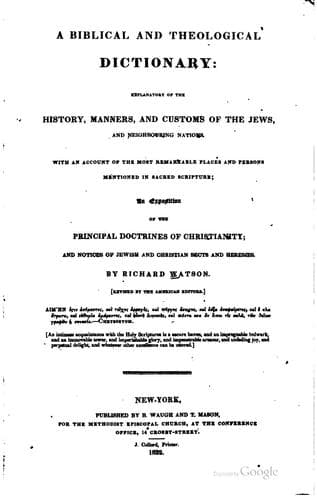
A Biblical and Theological Dictionary: explanatory of the history, manners, and customs of the Jews, and neighbouring nationsWatson, Richard
Religion
A Biblical and Theological Dictionary: explanatory of the history, manners, and customs of the Jews, and neighbouring nations
Watson, Richard
Bible -- Dictionaries; Theology -- Dictionaries
APOCRYPHA, books not admitted into the sacred canon, being either
spurious, or at least not acknowledged to be divine. The word Apocrypha
is of Greek origin, and is either derived from the words ἀπὸ τῆς
κρύπτῆς, because the books in question were removed _from the crypt_,
chest, ark, or other receptacle in which the sacred books were deposited
whose authority was never doubted, or more probably from the verb
ἀποκρύπτω, _to hide_ or _conceal_, because they were concealed from the
generality of readers, their authority not being recognised by the
church, and because they are books which are destitute of proper
testimonials, their original being obscure, their authors unknown, and
their character either heretical or suspected. The advocates of the
church of Rome, indeed, affirm that some of these books are divinely
inspired; but it is easy to account for this: the apocryphal writings
serve to countenance some of the corrupt practices of that church. The
Protestant churches not only account those books to be apocryphal and
merely human compositions which are esteemed such by the church of Rome,
as the Prayer of Manasseh, the third and fourth books of Esdras, the
addition at the end of Job, and the hundred and fifty-first Psalm; but
also the books of Tobit, Judith, the additions to the book of Esther,
Wisdom, Ecclesiasticus, Baruch the Prophet, with the Epistle of
Jeremiah, the Song of the Three Children, the Story of Susanna, the
Story of Bel and the Dragon, and the first and second books of
Maccabees. The books here enumerated are unanimously rejected by
Protestants for the following reasons:--
1. They possess no authority whatever, either external or internal, to
procure their admission into the sacred canon. None of them are extant
in Hebrew; all of them are in the Greek language, except the fourth book
of Esdras, which is only extant in Latin. They were written for the most
part by Alexandrian Jews, subsequently to the cessation of the prophetic
spirit, though before the promulgation of the Gospel. Not one of the
writers in direct terms advances a claim to inspiration; nor were they
ever received into the sacred canon by the Jewish church, and therefore
they were not sanctioned by our Saviour. No part of the apocrypha is
quoted, or even alluded to, by him or by any of his Apostles; and both
Philo and Josephus, who flourished in the first century of the Christian
æra, are totally silent concerning them.
Public-domain text, read in full here on John Shaqi.
Reviews
Reviews
No reviews yet
Be the first to share your thoughts on this work.
Elsewhere in the archive
Join the Discussion
Join the discussion
Sign in to leave a comment or review.
Sign InorCreate an account