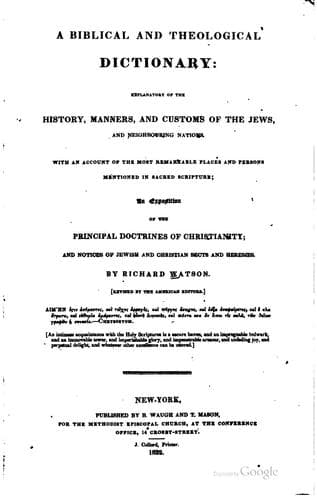
A Biblical and Theological Dictionary: explanatory of the history, manners, and customs of the Jews, and neighbouring nationsWatson, Richard
Religion
A Biblical and Theological Dictionary: explanatory of the history, manners, and customs of the Jews, and neighbouring nations
Watson, Richard
Bible -- Dictionaries; Theology -- Dictionaries
2. The apocryphal books were not admitted into the canon of Scripture
during the first four centuries of the Christian church. They are not
mentioned in the catalogue of inspired writings made by Melito bishop of
Sardis, who flourished in the second century, nor in those of Origen in
the third century, of Athanasius, Hilary, Cyril of Jerusalem,
Epiphanius, Gregory Nazianzen, Amphilochius, Jerom, Rufinus, and others
of the fourth century; nor in the catalogue of canonical books
recognised by the council of Laodicea, held in the same century, whose
canons were received by the catholic church; so that as Bishop Burnet
well observes, we have the concurring sense of the whole church of God
in this matter. To this decisive evidence against the canonical
authority of the apocryphal books, we may add that they were never read
in the Christian church until the fourth century; when, as Jerom informs
us, they were read “for example of life, and instruction of planners;
but were not applied to establish any doctrine.” And contemporary
writers state, that although they were not approved as canonical or
inspired writings, yet some of them, particularly Judith, Wisdom, and
Ecclesiasticus, were allowed to be perused by catechumens. As a proof
that they were not regarded as canonical in the fifth century, Augustine
relates, that when the book of Wisdom and other writings of the same
class were publicly read in the church, they were given to the readers
or inferior ecclesiastical officers, who read them in a lower place than
those which were universally acknowledged to be canonical, which were
read by the bishops and presbyters in a more eminent and conspicuous
manner. To conclude: notwithstanding the veneration in which these books
were held by the western church, it is evident that the same authority
was never ascribed to them as to the Old and New Testament until the
last council of Trent, at its fourth session, presumed to place them all
(except the Prayer of Manasseh and the third and fourth books of Esdras)
in the same rank with the inspired writings of Moses and the Prophets.
Public-domain text, read in full here on John Shaqi.
Reviews
Reviews
No reviews yet
Be the first to share your thoughts on this work.
Elsewhere in the archive
Join the Discussion
Join the discussion
Sign in to leave a comment or review.
Sign InorCreate an account