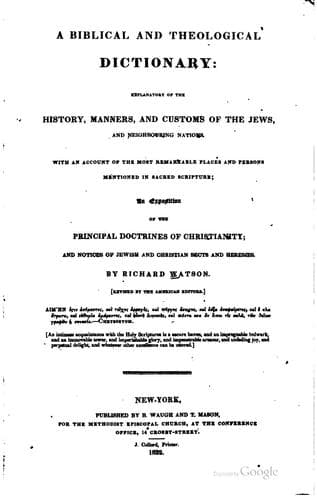
A Biblical and Theological Dictionary: explanatory of the history, manners, and customs of the Jews, and neighbouring nationsWatson, Richard
Religion
A Biblical and Theological Dictionary: explanatory of the history, manners, and customs of the Jews, and neighbouring nations
Watson, Richard
Bible -- Dictionaries; Theology -- Dictionaries
APOLLINARIANS, or Apollinarists, or, as they are called by Epiphanius,
Dimaritæ, a sect who derive their principal name from Apollinaris,
bishop of Laodicea, in the fourth century. Apollinaris strenuously
defended the divinity of Christ against the Arians; but by indulging too
freely in philosophical distinctions and subtleties, he denied in some
measure his humanity. He maintained that the body which Christ assumed
was endowed with a sensitive, and not a rational, soul; and that the
divine nature performed the functions of reason, and supplied the place
of the intellectual principle in man. Hence it seemed to follow, that
the divine nature in Christ was blended with the human and suffered with
it the pains of crucifixion and death. Apollinaris and his followers
have been charged with other errors by certain ancient waiters; but it
is not easy to determine how far their charge is worthy of credit. The
doctrine of Apollinaris was first condemned by a council at Alexandria
in 362, and afterward in a more formal manner by a council at Rome in
375, and by another council in 378, which deposed Apollinaris from his
bishopric. In short, it was attacked at the same time by the laws of the
emperors, the decrees of councils, and the writings of the learned; and
sunk by degrees under their united force.
APOLLOS was a Jew of Alexandria, who came to Ephesus in the year of our
Lord 54, during the absence of St. Paul, who had gone to Jerusalem, Acts
xviii, 24. He was an eloquent man, and mighty in the Scriptures; but he
knew only the baptism of John, and was not fully informed of the higher
branches of Gospel doctrine. However, he acknowledged that Jesus Christ
was the Messiah, and declared himself openly as his disciple. At
Ephesus, therefore, he began to speak boldly in the synagogue, and
demonstrated by the Scriptures that Jesus was the Christ. Aquila and
Priscilla, having heard him there, took him with them, and instructed
him more fully in the ways of God. Some time after, he was inclined to
go into Achaia, and the brethren wrote to the disciples there, desiring
them to receive him. He was very useful at Corinth, where he watered
what St. Paul had planted, 1 Cor. iii, 6. It has been supposed, that the
great admiration of his disciples for him tended to produce a schism.
Some said, “I am of Paul;” some, “I am of Apollos;” and others, “I am of
Cephas.” But this division, which St. Paul mentions and reproves in his
First Epistle to the Corinthians, did not prevent Paul and Apollos,
personally, from being closely united in the bonds of Christian charity
and affection. Apollos, hearing that the Apostle was at Ephesus, went to
meet him, and was there when St. Paul wrote the First Epistle to the
Corinthians; in which he observes, that he had earnestly entreated
Apollos to return to Corinth: but though he had not prevailed with him,
Apollos gave him room to hope that he would visit that city at a
favourable opportunity.
Public-domain text, read in full here on John Shaqi.
Reviews
Reviews
No reviews yet
Be the first to share your thoughts on this work.
Elsewhere in the archive
Join the Discussion
Join the discussion
Sign in to leave a comment or review.
Sign InorCreate an account