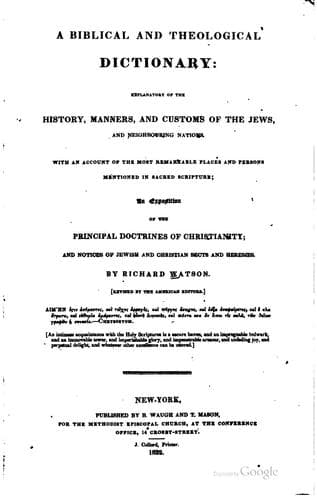
A Biblical and Theological Dictionary: explanatory of the history, manners, and customs of the Jews, and neighbouring nationsWatson, Richard
Religion
A Biblical and Theological Dictionary: explanatory of the history, manners, and customs of the Jews, and neighbouring nations
Watson, Richard
Bible -- Dictionaries; Theology -- Dictionaries
It is not the least singular circumstance in the history of this
extraordinary people, that those who, in the enthusiasm of their first
successes, were the sworn foes of literature, should become for several
ages its exclusive patrons. Almansor, the founder of Bagdad, has the
merit of first exciting this spirit, which was encouraged in a still
greater degree by his grandson Almamon. This caliph employed his agents
in Armenia, Syria, Egypt, and at Constantinople, in collecting the most
celebrated works on Grecian science, and had them translated into the
Arabic language. Philosophy, astronomy, geometry, and medicine, were
thus introduced and taught; public schools were established; and
learning, which had altogether fled from Europe, found an asylum on the
banks of the Tigris. Nor was this spirit confined to the capital: native
works began to appear; and by the hands of copyists were multiplied out
of number, for the information of the studious, or the pride of the
wealthy. The rage for literature extended to Egypt and to Spain. In the
former country, the Fatimites collected a library of a hundred thousand
manuscripts, beautifully transcribed, and very elegantly bound; and in
the latter, the Ommiades formed another of six hundred thousand volumes;
forty-four of which were employed in the catalogue. Their capital,
Cordova, with the towns of Malaga, Almeria, and Murcia, produced three
hundred writers; and seventy public libraries were established in the
cities of Andalusia. What a change since the days of Omar, when the
splendid library of the Ptolemies was wantonly destroyed by the same
people! A retribution, though a slight one, was thus made for their
former devastations; and many Grecian works, lost in the original, have
been recovered in their Arabic dress. Neither was this learning confined
to mere parade, though much of it must undoubtedly have been so. Their
proficiency in astronomy and geometry is attested by their astronomical
tables, and by the accuracy with which, in the plain of Chaldea, a
degree of the great circle of the earth was measured. But it was in
medicine that, in this dark age, the Arabians shone most: the works of
Hippocrates and Galen had been translated and commented on; their
physicians were sought after by the princes of Asia and Europe; and the
names of Rhazis, Albucasis, and Avicenna are still revered by the
members of the healing art. So little, indeed, did the physicians of
Europe in that age know of the history of their own science, that they
were astonished, on the revival of learning, to find in the ancient
Greek authors those systems for which they thought themselves indebted
to the Arabians!
Public-domain text, read in full here on John Shaqi.
Reviews
Reviews
No reviews yet
Be the first to share your thoughts on this work.
Elsewhere in the archive
Join the Discussion
Join the discussion
Sign in to leave a comment or review.
Sign InorCreate an account