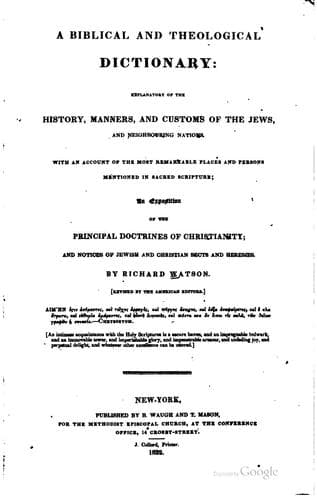
A Biblical and Theological Dictionary: explanatory of the history, manners, and customs of the Jews, and neighbouring nationsWatson, Richard
Religion
A Biblical and Theological Dictionary: explanatory of the history, manners, and customs of the Jews, and neighbouring nations
Watson, Richard
Bible -- Dictionaries; Theology -- Dictionaries
The last remnant of Arabian science was found in Spain; from whence it
was expelled in the beginning of the seventeenth century, by the
intemperate bigots of that country, who have never had any thing of
their own with which to supply its place. The Arabians are the only
people who have preserved their descent, their independence, their
language, and their manners and customs, from the earliest ages to the
present times; and it is among them that we are to look for examples of
patriarchal life and manners. A very lively sketch of this mode of life
is given by Sir R. K. Porter, in the person and tribe of an Arab sheik,
whom he encountered in the neighbourhood of the Euphrates. “I had met
this warrior,” says Sir R. K. P., “at the house of the British resident
at Bagdad; and came, according to his repeated wish, to see him in a
place more consonant with his habits, the tented field; and, as he
expressed it, ‘at the head of his children.’ As soon as we arrived in
sight of his camp, we were met by crowds of its inhabitants, who, with a
wild and hurrying delight, led us toward the tent of their chief. The
venerable old man came forth to the door, attended by his subjects of
all sizes and descriptions, and greeted us with a countenance beaming
kindness; while his words, which our interpreter explained, were
demonstrative of patriarchal welcome. One of my Hindoo troopers spoke
Arabic; hence the substance of our succeeding discourse was not lost on
each other. Having entered, I sat down by my host; and the whole of the
persons present, to far beyond the boundaries of the tent, (the sides of
which were open,) seated themselves also, without any regard to those
more civilized ceremonies of subjection, the crouching of slaves, or the
standing of vassalage. These persons, in rows beyond rows, appeared just
as he had described, the offspring of his house, the descendants of his
fathers, from age to age; and like brethren, whether holding the highest
or the lowest rank, they seemed to gather round their common parent. But
perhaps their sense of perfect equality in the mind of their chief could
not be more forcibly shown, than in the share they took in the objects
which appeared to interest his feelings; and as I looked from the elders
or leaders of the people, seated immediately around him, to the circles
beyond circles of brilliant faces, bending eagerly toward him and his
guest, (all, from the most respectably clad to those with hardly a
garment covering their active limbs, earnest to evince some attention to
the stranger he bade welcome,) I thought I had never before seen so
complete an assemblage of fine and animated countenances, both old and
young: nor could I suppose a better specimen of the still existing state
of the true Arab; nor a more lively picture of the scene which must have
presented itself, ages ago, in the fields of Haran, when Terah sat in
his tent door, surrounded by his sons, and his sons’ sons, and the
people born in his house.
Public-domain text, read in full here on John Shaqi.
Reviews
Reviews
No reviews yet
Be the first to share your thoughts on this work.
Elsewhere in the archive
Join the Discussion
Join the discussion
Sign in to leave a comment or review.
Sign InorCreate an account