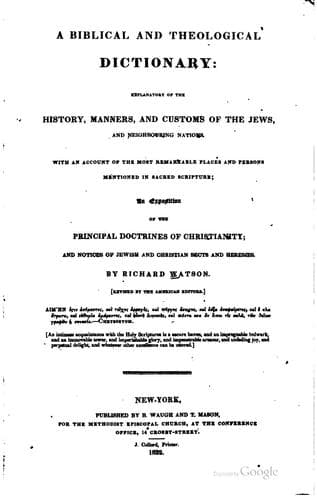
A Biblical and Theological Dictionary: explanatory of the history, manners, and customs of the Jews, and neighbouring nationsWatson, Richard
Religion
A Biblical and Theological Dictionary: explanatory of the history, manners, and customs of the Jews, and neighbouring nations
Watson, Richard
Bible -- Dictionaries; Theology -- Dictionaries
The venerable Arabian sheik was also seated on
the ground with a piece of carpet spread under him; and, like his
ancient Chaldean ancestor, turned to the one side and the other,
graciously answering or questioning the groups around him, with an
interest in them all which clearly showed the abiding simplicity of his
government, and their obedience. On the smallest computation, such must
have been the manners of these people for more than three thousand
years; thus, in all things, verifying the prediction given of Ishmael at
his birth, that he, in his posterity, should ‘be a wild man,’ and always
continue to be so, though ‘he shall dwell for ever in the presence of
his brethren.’ And that an acute and active people, surrounded for ages
by polished and luxurious nations, should from their earliest to their
latest times, be still found _a wild people, dwelling in the presence of
all their brethren_, (as we may call these nations,) unsubdued and
unchangeable, is, indeed, a standing miracle: one of those mysterious
facts which establish the truth of prophecy.” But although the manners
of the Arabians have remained unaltered through so many ages, and will
probably so continue, their religion, as we have seen, has sustained an
important change; and must again, in the fulness of time, give place to
a faith more worthy of the people.
St. Paul first preached the Gospel in Arabia, Gal. i, 17. Christian
churches were subsequently founded, and many of their tribes embraced
Christianity prior to the fifth century; most of which appear to have
been tinctured with the Nestorian heresy. At this time, however, it does
not appear that the Arabians had any version of the Scriptures in their
own language, to which some writers attribute the ease with which they
were drawn into the Mohammedan delusion; while the “Greeks, Syrians,
Armenians, Abyssinians, Copts, and others,” who enjoyed that privilege,
were able to resist it.
ARAM, the fifth son of Shem, Gen. x, 22. He was the father of the
Syrians, who from him were called Aramæans, or Aramites.
Public-domain text, read in full here on John Shaqi.
Reviews
Reviews
No reviews yet
Be the first to share your thoughts on this work.
Elsewhere in the archive
Join the Discussion
Join the discussion
Sign in to leave a comment or review.
Sign InorCreate an account