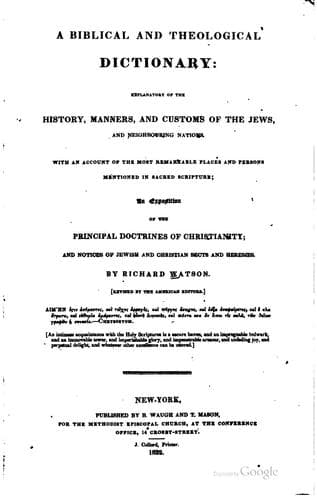
A Biblical and Theological Dictionary: explanatory of the history, manners, and customs of the Jews, and neighbouring nationsWatson, Richard
Religion
A Biblical and Theological Dictionary: explanatory of the history, manners, and customs of the Jews, and neighbouring nations
Watson, Richard
Bible -- Dictionaries; Theology -- Dictionaries
ARARAT, a mountain of Asia, in Armenia, on which the ark of Noah rested
after the cessation of the deluge. Concerning the etymology of the name,
Dr. Bryant observes, that it is a compound of _Ar-Arat_, and signifies
“the mountain of descent,” being equivalent to הר־ירר, of the Hebrews.
Of the precise situation of this mountain, different accounts have been
given. Some have supposed that it was one of the mountains which divide
Armenia on the south from Mesopotamia, and that part of Assyria
inhabited by the Curds, from whom those mountains took the name of
Curdue, or Cardu; by the Greeks denominated _Gordyæi_. It is called by
the Arabs _Al-Judi_, and also _Thamanin_. In confirmation of this
opinion, it is alleged that the remains of the ark were to be seen on
these mountains; and it is said, that Berosus and Abydenus both declare,
that such a report existed in their time. Epiphanius pretends, if we may
credit his assertion, that the relics of the ark were to be seen in his
day; and we are farther told, that the emperor Heraclius went from the
town of Thamanin, up the mountain Al-Judi, and saw the place of the ark.
Others maintain, that mount Ararat was situated toward the middle of
Armenia, near the river Araxes, or Aras, about twelve miles from it,
according to Tournefort, above two hundred and eighty miles distant from
Al-Judi, to the north-east. Ararat seems to be a part of that vast chain
of mountains called Caucasus and Taurus; and upon these mountains, and
in the adjacent country, were preserved more authentic accounts of the
ark than in almost any other part of the world. The region about Ararat,
called Araratia, was esteemed among the ancients as nearly a central
part of the earth; and it is certainly as well calculated as any other
for the accommodation of its first inhabitants, and for the migration of
colonies, upon the increase of mankind. The soil of the country was very
fruitful, and especially of that part where the patriarch made his first
descent. The country also was very high, though it had fine plains and
valleys between the mountains. Such a country, therefore, must, after
the flood, have been the soonest exsiccated, and, consequently, the
soonest habitable.
Public-domain text, read in full here on John Shaqi.
Reviews
Reviews
No reviews yet
Be the first to share your thoughts on this work.
Elsewhere in the archive
Join the Discussion
Join the discussion
Sign in to leave a comment or review.
Sign InorCreate an account