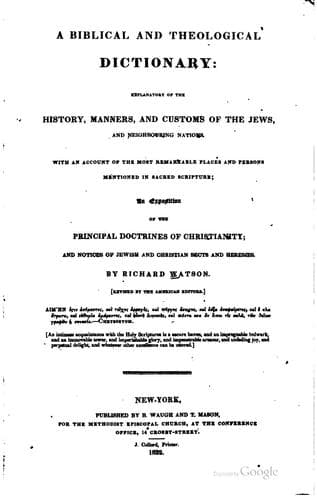
A Biblical and Theological Dictionary: explanatory of the history, manners, and customs of the Jews, and neighbouring nationsWatson, Richard
Religion
A Biblical and Theological Dictionary: explanatory of the history, manners, and customs of the Jews, and neighbouring nations
Watson, Richard
Bible -- Dictionaries; Theology -- Dictionaries
Son was naturally of God? It was granted: Even we, said they, are of
God, ‘of whom are all things.’” At length the Athanasians collected a
number of texts, which they conceived amounted to full proof of the
Son being of one and _the same_ substance with the Father; the Arians
admitted he was of _like_ substance, the difference in the Greek
phrases being only in a single letter,--ὁμοούσιος, _homoousios_ and
ὁμοιούσιος, _homoiousios_. At length the former was decreed to be the
orthodox faith, and the Nicene creed was framed as it remains at this
day so far as concerns the person of the Son of God, who is said to be
“begotten of his Father before all worlds; God of God, Light of Light,
very God of very God, begotten, not made, of one substance with the
Father, by whom all things were made,” &c.
Arius was now excommunicated. The sentence of the council pronounced
against him and his associates was followed by another of the emperor,
whereby the excommunicated persons were condemned to banishment, that
they might be debarred the society of their countrymen whom the church
had judged unworthy to remain in her communion. Soon after which,
Eusebius of Nicomedia, and Theognis of Nice, being found to continue
their countenance and protection to the Arian cause, to communicate with
those whom they had anathematized, and to concur in those sentiments
which they had condemned by their subscriptions; they were both
subjected to the same penalty of exile by the emperor, and were actually
deposed, (as we learn from Athanasius,) and had successors ordained to
their sees, though history is silent as to the council by which this was
done. But such was the good nature and credulity of Constantine, that
these men, by their usual artifices, easily imposed upon him, and
brought him to such a full persuasion of their agreement with the Nicene
faith, that in about three years’ time they were not only recalled from
banishment, but restored to their sees, and to a considerable degree of
interest at court. Their thorough attachment to the cause of Arius, and
their hatred of Athanasius, who had so vigorously withstood them in the
council, and was now advanced to the see of Alexandria, made them
watchful of every opportunity to defeat the decisions of the council.
Public-domain text, read in full here on John Shaqi.
Reviews
Reviews
No reviews yet
Be the first to share your thoughts on this work.
Elsewhere in the archive
Join the Discussion
Join the discussion
Sign in to leave a comment or review.
Sign InorCreate an account