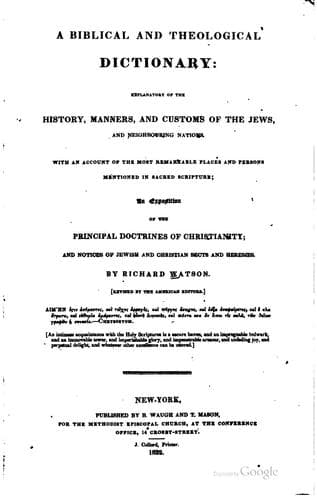
A Biblical and Theological Dictionary: explanatory of the history, manners, and customs of the Jews, and neighbouring nationsWatson, Richard
Religion
A Biblical and Theological Dictionary: explanatory of the history, manners, and customs of the Jews, and neighbouring nations
Watson, Richard
Bible -- Dictionaries; Theology -- Dictionaries
In the meantime one who wished well to their designs, and whom
Constantia had upon her death bed recommended to the emperor, did so far
prevail upon the easy credulity of Constantine, by complaining that
Arius had been misrepresented, and differed nothing in his sentiments
from the Nicene fathers, that the indulgent emperor recalled him from
his banishment, and required him to exhibit in writing, a confession of
his faith. He did this in such terms as, though they admitted of a
latent reservation, yet bore the appearance of being entirely catholic;
and therefore not only gave satisfaction to the emperor, but even
offended some of his own followers, who from that time forth separated
from him. The discerning Athanasius was not so easily imposed upon as
Constantine; but, well assured of the heretic’s prevarication, was
resolute in refusing to admit him to communion, whom the Nicene council
had so openly condemned. Upon this the emperor sent for Arius to
Constantinople, and insisted upon his being received into communion, by
Alexander, bishop of that city. However, on the day before this was to
have taken place, Arius died suddenly from a complaint in his bowels.
Some attributed this to poison; others to the judgment of God. The
emperor did not long survive; and Constantius, his successor, became
warmly attached to the Arian cause, as were all the court party.
Successive emperors took different sides, and thus was the peace of the
church agitated for many years, and practical religion sacrificed
alternately to the dogmas or the interests of one party or the other;
and each was in turn excommunicated, fined, imprisoned, or banished.
Constantius supported Arianism triumphantly, Julian laughed at both
parties, but persecuted neither, Jovian supported the Nicene doctrine.
Valentinian, and his brother Valens, took contrary sides; the former
supporting Athanasianism in the west, and the latter Arianism in the
east; so that what was orthodoxy at Rome was heresy at Constantinople,
and _vice versa_. The Arians themselves were not unanimous, but divided
into various shades of sentiment, under their respective leaders; as
Eusebians, Eudoxians, Acasians, Aëtians, &c; but the more general
distinction was into Arians and Semi-Arians; the former sinking the
character of the Son of God into that of a mere creature, while the
latter admitted every thing but the _homoousian_ doctrine, or his
absolute equality with the Father. After this period we hear little of
Arianism, till it was revived in England in the beginning of the last
century by the eccentric Mr. Whiston, by Mr. Emlyn, and Dr. Samuel
Clarke. The latter was what may be called a _high_ or Semi-Arian, who
came within a shade of orthodoxy; the two _former_ were low Arians,
reducing the rank of our Saviour to the scale of angelic beings--a
creature “made out of nothing.” Since this time, however, both Arians
and Socinians are sunk into the common appellation of _Unitarians_, or
Public-domain text, read in full here on John Shaqi.
Reviews
Reviews
No reviews yet
Be the first to share your thoughts on this work.
Elsewhere in the archive
Join the Discussion
Join the discussion
Sign in to leave a comment or review.
Sign InorCreate an account