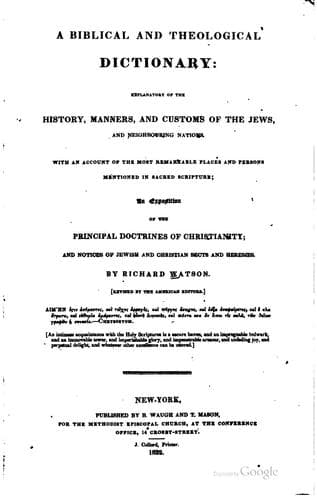
A Biblical and Theological Dictionary: explanatory of the history, manners, and customs of the Jews, and neighbouring nationsWatson, Richard
Religion
A Biblical and Theological Dictionary: explanatory of the history, manners, and customs of the Jews, and neighbouring nations
Watson, Richard
Bible -- Dictionaries; Theology -- Dictionaries
rather _Humanitarians_, who believe our Saviour (as Dr. Priestley
expresses it) to be “a _man_ like themselves.” The last advocates of the
pure Arian doctrine, of any celebrity, were Mr. Henry Taylor, (under the
signature of Ben Mordecai,) and Dr. Richard Price, in his “Sermons on
the Christian Doctrine.” It may be proper to observe, that the Arians,
though they denied the absolute _eternity_ of the Son, strongly
contended for his preëxistence, as the _Logos_, or the Word of God, “by
whom the worlds were made;” and admitted, more or less explicitly, the
sacrifice which he offered for sin upon the cross.
ARIEL, the capital city of Moab, frequently mentioned in Scripture, Ezra
viii, 16. See MOAB.
ARIMATHEA, or RAMAH, now called Ramlè, or Ramla, a pleasant town,
beautifully situated on the borders of a fertile and extensive plain,
abounding in gardens, vineyards, olive and date trees. It stands about
thirty miles north-west of Jerusalem, on the high road to Jaffa. At this
Rama, which was likewise called Ramathaim Zophim, as lying in the
district of Zuph, or Zoph, Samuel was born, 1 Sam. i. This was likewise
the native place of Joseph, called Joseph of Arimathea, who begged and
obtained the body of Jesus from Pilate, Matt. xxvi, 57. There was
another Ramah, about six miles north of Jerusalem, in a pass which
separated the kingdoms of Israel and Judah, which Baasha, king of
Israel, took and began to fortify; but he was obliged to relinquish it,
in consequence of the alliance formed between Asa, king of Judah, and
Benhadad, king of Syria, 1 Kings xv. This is the Ramah, supposed to be
alluded to in the lamentation of Rachel for her children.
ARISTARCHUS, spoken of by St. Paul in his Epistle to the Colossians, iv,
10, and often mentioned in the Acts of the Apostles. He was a
Macedonian, and a native of Thessalonica. He accompanied St. Paul to
Ephesus, and there continued with him during the two years of his abode
in that place, sharing with him in all the dangers and labours of the
ministry, Acts xix, 29; xx, 4; xxvii, 2. He was near losing his life in
a tumult raised by the Ephesian silversmiths. He left Ephesus with the
Apostle, and went with him into Greece. From thence he attended him into
Asia; from Asia into Judea, and from Judea to Rome.
Public-domain text, read in full here on John Shaqi.
Reviews
Reviews
No reviews yet
Be the first to share your thoughts on this work.
Elsewhere in the archive
Join the Discussion
Join the discussion
Sign in to leave a comment or review.
Sign InorCreate an account