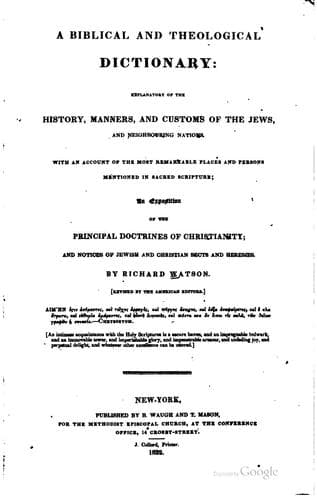
A Biblical and Theological Dictionary: explanatory of the history, manners, and customs of the Jews, and neighbouring nationsWatson, Richard
Religion
A Biblical and Theological Dictionary: explanatory of the history, manners, and customs of the Jews, and neighbouring nations
Watson, Richard
Bible -- Dictionaries; Theology -- Dictionaries
ARK, _arca_, denotes a kind of floating vessel built by Noah, for the
preservation of himself and family, with several species of animals
during the deluge. The Hebrew word by which the ark is expressed, is תבה
or תיבה, the constructive form of תבה, which is evidently the Greek
θίβη; and so the LXX render the word in Exod. ii, 3, where only it again
occurs. They also render it κιβωτὸν; Josephus, λαρνάκα; and the Vulgate,
_arcam_; signifying an ark, coffer, or chest. Although the ark of Noah
answered, in some respects, the purpose of a ship, it is not so certain
that it was of the same form and shape. It has been inconclusively
argued by Michaelis and some others, that if its form had not been like
that of a ship, it could not have resisted the force of the waves;
because it was not intended to be conducted, like a ship, from one place
to another, but merely “to float on the surface of the waters,” Gen.
vii, 17. It appears to have had neither helm, nor mast, nor oars; but
was merely a bulky capacious vessel, light enough to be raised aloft
with all its contents, by the gradual rise of the deluge. Its shape,
therefore, was of little importance; more especially as it seems to have
been the purpose of Providence, in this whole transaction, to signify to
those who were saved, as well as to their latest posterity, that their
preservation was not in any degree effected by human contrivance. The
ark in which Moses was exposed bears the same name; and some have
thought that both were of the same materials. With respect to the
etymology of the Hebrew word, the most rational seems to be that of
Clodius, who derives it from the Arabic word תאה, “he collected,” from
which is formed תבה, or תיבה, denoting a place in which things are
collected. Foster deduces it from two Egyptian words, _thoi_, “a ship,”
and _bai_, “a palm tree branch”; and such ships are still to be seen not
only in Egypt, but in India and other countries; particularly in some
isles of the Pacific Ocean.
To the insufficiency of the ark to contain all the creatures said to
have been brought into it, objections have, at different times, been
made. Bishop Wilkins and others have learnedly discussed this subject,
and afforded the most satisfactory answers. Dr. Hales proves the ark to
have been of the burden of forty-two thousand four hundred and thirteen
tons; and asks, “Can we doubt of its being sufficient to contain eight
persons, and about two hundred or two hundred and fifty pair of
four-footed animals, (a number to which, according to M. Buffon, all the
various distinct species may be reduced,) together with all the
subsistence necessary for a twelvemonth, with the fowls of the air, and
such reptiles and insects as cannot live under water?” All these various
animals were controlled by the power of God, whose special agency is
supposed in the whole transaction, and “the lion was made to lie down
with the kid.”
Public-domain text, read in full here on John Shaqi.
Reviews
Reviews
No reviews yet
Be the first to share your thoughts on this work.
Elsewhere in the archive
Join the Discussion
Join the discussion
Sign in to leave a comment or review.
Sign InorCreate an account