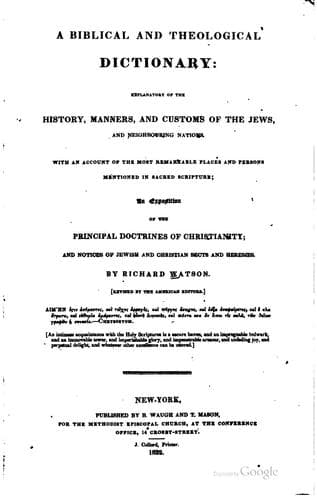
A Biblical and Theological Dictionary: explanatory of the history, manners, and customs of the Jews, and neighbouring nationsWatson, Richard
Religion
A Biblical and Theological Dictionary: explanatory of the history, manners, and customs of the Jews, and neighbouring nations
Watson, Richard
Bible -- Dictionaries; Theology -- Dictionaries
The religion of the Armenians is a corrupt Christianity of the sect of
Eutyches; that is, they own but one nature in Jesus Christ. Their rites
partake of those of the Greek and Latin churches, but they reject the
idolatries of both. It is indeed a remarkable instance of the firmness
of this people, that while the surrounding nations submitted to the
religion as well as the arms of the Turks, they have preserved the
purity of their ancient faith, such as it is, to the present day. It
cannot be supposed but that the Turks used every effort to impose on the
conquered Armenians the doctrines of the Koran. More tolerant, indeed,
than the Saracens, liberty of conscience was still not to be purchased
of them but by great sacrifices, which for three centuries the Armenians
have patiently endured, and exhibit to the world an honourable and
solitary instance of a successful national opposition of Christianity to
Mohammedanism.
ARMENIAN CHURCH, a branch, originally, of the Greek church, residing in
Armenia. They probably received Christianity in the fourth century. Mr.
Yeates gives the most recent account of them:--
“Their whole ecclesiastical establishment is under the government of
four patriarchs; the first has his residence in Echmiadzin, or
Egmiathin, near Irivan; the second, at Sis, in the lesser Armenia; the
third, in Georgia; and the fourth, in Achtamar, or Altamar, on the Lake
of Van; but the power of the two last is bounded within their own
diocesses, while the others have more extensive authority, and the
patriarch of Egmiathan has, or had, under him eighteen bishops, beside
those who are priors of monasteries. The Armenians every where perform
divine service in their own tongue, in which their liturgy and offices
are written, in the dialect of the fourth or fifth centuries. They have
the whole Bible translated from the Septuagint, as they say, so early as
the time of Chrysostom. The Armenian confession is similar to that of
the Jacobite Christians, both being Monophysites, acknowledging but one
nature in the person of Christ; but this, according to Mr. Simon, is
little more than a dispute about terms; few of them being able to enter
into the subtilties of polemics.
“In the year 1664, an Armenian bishop, named Uscan, visited Europe for
the purpose of getting printed the Armenian Bible, and communicated the
above particulars to Mr. Simon. In 1667, a certain patriarch of the
lesser Armenia visited Rome, and made a profession of faith which was
considered orthodox, and procured him a cordial reception, with the hope
of reconciling the Armenian Christians to the Roman church; but, before
he got out of Italy, it was found he had prevaricated, and still
persisted in the errors of his church. About this time, Clement IX,
wrote to the king of Persia, in favour of some Catholic converts in
Armenia, and received a favourable answer; but the Armenian church could
never be persuaded to acknowledge the authority of Rome.
Public-domain text, read in full here on John Shaqi.
Reviews
Reviews
No reviews yet
Be the first to share your thoughts on this work.
Elsewhere in the archive
Join the Discussion
Join the discussion
Sign in to leave a comment or review.
Sign InorCreate an account