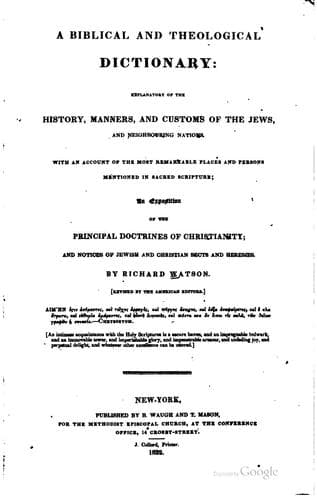
A Biblical and Theological Dictionary: explanatory of the history, manners, and customs of the Jews, and neighbouring nationsWatson, Richard
Religion
A Biblical and Theological Dictionary: explanatory of the history, manners, and customs of the Jews, and neighbouring nations
Watson, Richard
Bible -- Dictionaries; Theology -- Dictionaries
ABOMINATION. This term was used with regard to the Hebrews, who, being
shepherds, are said to have been an abomination to the Egyptians;
because they sacrificed the animals held sacred by that people, as oxen,
goats, sheep, &c, which the Egyptians esteemed unlawful. This word is
also applied in the sacred writings to idolatry and idols, not only
because the worship of idols is in itself an abominable thing, but
likewise because the ceremonies of idolaters were almost always of an
infamous and licentious nature. For this reason, Chrysostom affirms,
that every idol, and every image of a man, was called an abomination
among the Jews. The “abomination of desolation” foretold by the Prophet
Daniel, x, 27, xi, 31, is supposed by some interpreters to denote the
statue of Jupiter Olympius, which Antiochus Epiphanes caused to be
erected in the temple of Jerusalem. The second of the passages above
cited may probably refer to this circumstance, as the statue of Jupiter
did, in fact, “make desolate,” by banishing the true worship of God, and
those who performed it, from the temple. But the former passage,
considered in its whole connection, bears more immediate reference to
that which the evangelists have denominated the “abomination of
desolation,” Matt. xxiv, 15, 16; Mark xiii, 14. This, without doubt,
signifies the ensigns of the Roman armies under the command of Titus,
during the last siege of Jerusalem. The images of their gods and
emperors were delineated on these ensigns; and the ensigns themselves,
especially the eagles, which were carried at the heads of the legions,
were objects of worship; and, according to the usual style of Scripture,
they were therefore an abomination. Those ensigns were placed upon the
ruins of the temple after it was taken and demolished; and, as Josephus
informs us, the Romans sacrificed to them there. The horror with which
the Jews regarded them, sufficiently appears from the account which
Josephus gives of Pilate’s introducing them into the city, when he sent
his army from Cæsarea into winter quarters at Jerusalem, and of
Vitellius’s proposing to march through Judea, after he had received
orders from Tiberius to attack Aretas, king of Petra. The people
supplicated and remonstrated, and induced Pilate to remove the army, and
Vitellius to march his troops another way. The Jews applied the above
passage of Daniel to the Romans, as we are informed by Jerome. The
learned Mr. Mede concurs in the same opinion. Sir Isaac Newton, _Obs. on
Daniel_ ix, xii, observes, that in the sixteenth year of the emperor
Adrian, B. C. 132, the Romans accomplished the prediction of Daniel by
building a temple to Jupiter Capitolinus, where the temple of God in
Jerusalem had stood. Upon this occasion the Jews, under the conduct of
Barchochab, rose up in arms against the Romans, and in the war had fifty
cities demolished, nine hundred and eighty-five of their best towns
destroyed, and five hundred and eighty thousand men slain by the sword;
Public-domain text, read in full here on John Shaqi.
Reviews
Reviews
No reviews yet
Be the first to share your thoughts on this work.
Join the Discussion
Join the discussion
Sign in to leave a comment or review.
Sign InorCreate an account