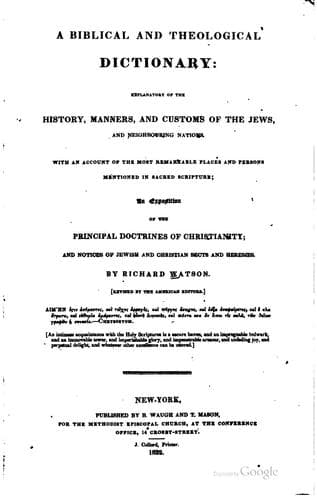
A Biblical and Theological Dictionary: explanatory of the history, manners, and customs of the Jews, and neighbouring nations — John Shaqi
A Biblical and Theological Dictionary: explanatory of the history, manners, and customs of the Jews, and neighbouring nationsWatson, Richard
Religion
A Biblical and Theological Dictionary: explanatory of the history, manners, and customs of the Jews, and neighbouring nations
Watson, Richard
Bible -- Dictionaries; Theology -- Dictionaries
Lustration, among the Romans, was a solemn ceremony by which they
purified their cities, fields, armies, or people, after any crime or
impurity. Lustrations might be performed by fire, by sulphur, by water,
and by air; the last was applied by ventilation, or fanning the thing to
be purified. All sorts of people, slaves excepted, might perform some
kind of lustration. When a person died the house was to be swept in a
particular manner; new married persons were sprinkled by the priest with
water. People sometimes, by way of purification, ran several times naked
through the streets. There was scarcely any action performed, at the
beginning and end of which some ceremony was not required to purify
themselves and appease the gods.
ABNER was the uncle of king Saul, and the general of his army. After
Saul’s death, he made Ishbosheth king; and for seven years supported the
family of Saul, in opposition to David; but in most of his skirmishes
came off with loss. While Ishbosheth’s and David’s troops lay near each
other, hard by Gibeon, Abner challenged Joab to select twelve of David’s
warriors to fight with an equal number of his. Joab consented: the
twenty-four engaged; and fell together on the spot. A fierce battle
ensued, in which Abner and his troops were routed. Abner himself was
hotly pursued by Asahel, whom he killed by a back stroke of his spear.
Still he was followed by Joab and Abishai, till he, who in the morning
sported with murder, was obliged at even to entreat that Joab would stay
his troops from the effusion of blood, 2 Sam. ii.
Not long after, Abner, taking it highly amiss for Ishbosheth to charge
him with lewd behaviour toward Rizpah, Saul’s concubine, vowed that he
would quickly transfer the whole kingdom into the hands of David. He
therefore commenced a correspondence with David, and had an interview
with him at Hebron. Abner had just left the feast at which David had
entertained him, when Joab, informed of the matter, warmly remonstrated,
asserting, that Abner had come as a spy. On his own authority he sent a
messenger to invite him back, to have some farther communication with
the king; and when Abner was come into Joab’s presence, the latter,
partly from jealousy lest Abner might become his superior, and partly to
revenge his brother Asahel’s death, mortally stabbed him in the act of
salutation. David, to show how heartily he detested the act, honoured
Abner with a splendid funeral, and composed an elegy on his death, 2
Sam. iii.
Public-domain text, read in full here on John Shaqi.
Reviews
Reviews
No reviews yet
Be the first to share your thoughts on this work.
Join the Discussion
Join the discussion
Sign in to leave a comment or review.
Sign InorCreate an account