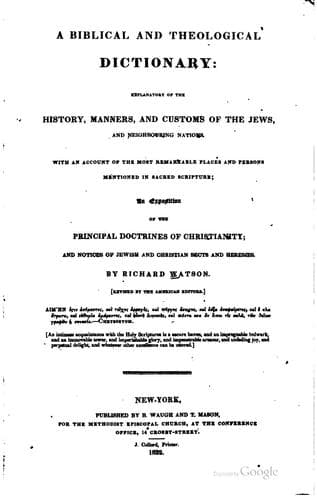
A Biblical and Theological Dictionary: explanatory of the history, manners, and customs of the Jews, and neighbouring nations — John Shaqi
A Biblical and Theological Dictionary: explanatory of the history, manners, and customs of the Jews, and neighbouring nationsWatson, Richard
Religion
A Biblical and Theological Dictionary: explanatory of the history, manners, and customs of the Jews, and neighbouring nations
Watson, Richard
Bible -- Dictionaries; Theology -- Dictionaries
1. Chaldea, the native country of Abraham, was inhabited by a pastoral
people, who were almost irresistibly invited to the study of the motions
of the heavenly bodies, by the peculiar serenity of the heavens in that
climate, and their habit of spending their nights in the open air in
tending their flocks. The first rudiments of astronomy, as a science, is
traced to this region; and here, too, one of the earliest forms of
idolatry, the worship of the host of heaven, usually called Tsabaism,
first began to prevail. During the three hundred and fifty years which
elapsed between the deluge and the birth of Abraham, this and other
idolatrous superstitions had greatly corrupted the human race, perverted
the simple forms of the patriarchal religion, and beclouded the import
of its typical rites. The family of Abraham was idolatrous, for his
“fathers served other gods beyond the flood,” that is, the great river
Euphrates; but whether he himself was in the early period of his life an
idolater, we are not informed by Moses. The Arabian and Jewish legends
speak of his early idolatry, his conversion from it, and of his zeal in
breaking the images in his father’s house; but these are little to be
depended upon. Before his call he was certainly a worshipper of the true
God; and that not in form only, but “in spirit and in truth.” Whilst
Abraham was still sojourning in Ur, “the God of glory” appeared to him,
and said unto him, “Get thee out of thy country and from thy kindred,
and go into the land which I shall show thee;” and so firm was his faith
in the providence and care of God, that although the place of his future
abode was not indicated, nor any information given of the nature of the
country, or the character of its inhabitants, he nevertheless promptly
obeyed, and “went out, not knowing whither he went.” Terah his father,
Nahor his brother, and Lot his nephew, the son of Haran his deceased
brother, accompanied him; a circumstance which indicates that if the
family had formerly been idolatrous it had now received the faith of
Abraham. They first migrated to Haran, or Charran, in Mesopotamia, a
flat, barren region westward of Ur; and after a residence there of a few
years, during which Terah had died, Abraham left Haran to go into
Palestine, taking with him Sarah his wife, who had no child, and Lot,
with his paternal property. Nahor appears to have been left in Haran. To
this second migration he was incited also by a Divine command,
accompanied by the promises of a numerous issue, that his seed should
become a great nation, and, above all, that “in him all the families of
the earth should be blessed;” in other words, that the Messiah, known
among the patriarchs as the promised “seed of the woman,” should be born
in his line. Palestine was then inhabited by the Canaanites, from whom
it was called Canaan. Abraham, leading his tribe, first settled at
Sechem, a valley between the mountains Ebal and Gerizim, where God
Public-domain text, read in full here on John Shaqi.
Reviews
Reviews
No reviews yet
Be the first to share your thoughts on this work.
Join the Discussion
Join the discussion
Sign in to leave a comment or review.
Sign InorCreate an account