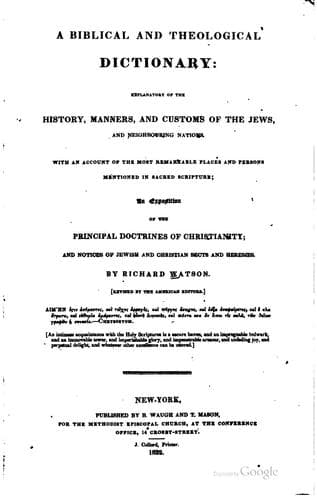
A Biblical and Theological Dictionary: explanatory of the history, manners, and customs of the Jews, and neighbouring nationsWatson, Richard
Religion
A Biblical and Theological Dictionary: explanatory of the history, manners, and customs of the Jews, and neighbouring nations
Watson, Richard
Bible -- Dictionaries; Theology -- Dictionaries
appeared to him and promised to give him the land of Canaan, and where,
as in other places in which he remained any time, he built an altar to
the Lord. He then removed to a hilly region on the north of Jericho; and
as the pastures were exhausted, migrated southward, till a famine drove
him into Egypt, probably the earliest, certainly the most productive,
corn country of the ancient world.
2. Here it may be observed, that the migrations of Abraham and his sons
show the manner in which the earth was gradually covered with people. In
those ages some cities had been built, and the country to some extent
about them cultivated; but wide spaces of unoccupied land lay between
them. A part of society following therefore the pastoral life, led forth
their flocks, and, in large family tribes, of which the parent was the
head, uniting both the sovereign power and the priesthood in himself,
and with a train of servants attached to the tribe by hereditary ties,
pitched their camps wherever a fertile and unappropriated district
offered them pasture. A few of these nomadic tribes appear to have made
the circuit of the same region, seldom going far from their native
seats; which would probably have been the case with Abraham, had he not
received the call of God to depart to a distant country. Others, more
bold, followed the track of rivers, and the sweep of fertile valleys,
and at length some built cities and formed settlements in those distant
regions; whilst others, either from attachment to their former mode of
life, or from necessity, continued in their pastoral occupations, and
followed the supplies afforded for their flocks by the still expanding
regions of the fertile earth. Wars and violences, droughts, famines, and
the constant increase of population, continued to impel these
innumerable, but at first, small streams of men into parts still more
remote. Those who settled on the sea coast began to use that element,
both for supplying themselves with a new species of food, and as a
medium of communication by vessels with other countries for the
interchange of such commodities as their own lands afforded with those
offered by maritime states, more or less distant. Thus were laid the
foundations of commerce, and thus the maritime cities were gradually
rendered opulent and powerful. Colonies were in time transported from
them by means of their ships, and settled on the coasts of still more
distant and fertile countries. Thus the migrations of the three
primitive families proceeded from the central regions of Armenia,
Mesopotamia, and Assyria; and in succession they established numerous
communities,--the Phenicians, Arabians, Egyptians, Ethiopians, and
Lybians southward;--the Persians, Indians, and Chinese eastward;--the
Scythians, Celts, and Tartars northward;--and the Goths, Greeks, and
Latins westward, even as far as the Peruvians and Mexicans of South
America, and the Indians of North America.
Public-domain text, read in full here on John Shaqi.
Reviews
Reviews
No reviews yet
Be the first to share your thoughts on this work.
Join the Discussion
Join the discussion
Sign in to leave a comment or review.
Sign InorCreate an account