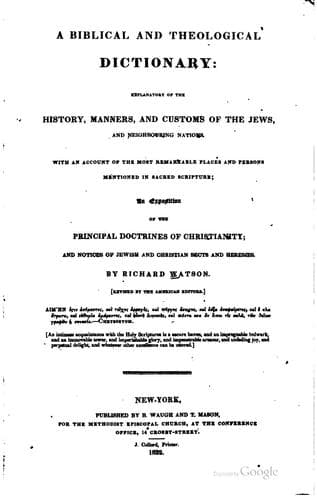
A Biblical and Theological Dictionary: explanatory of the history, manners, and customs of the Jews, and neighbouring nationsWatson, Richard
Religion
A Biblical and Theological Dictionary: explanatory of the history, manners, and customs of the Jews, and neighbouring nations
Watson, Richard
Bible -- Dictionaries; Theology -- Dictionaries
These united forces defeated the
Assyrian army, demolished the capital, and became masters of the empire,
B. C. 821.
“After the death of Sardanapalus,” says Mr. Playfair, “the Assyrian
empire was divided into three kingdoms; namely, the Median, Assyrian,
and Babylonian. Arbaces retained the supreme authority, and nominated
governors in Assyria and Babylon, who were honoured with the title of
kings, while they remained subject and tributary to the Persian monarchs
Belesis,” he says, “a Chaldean priest, who assisted Arbaces in the
conquest of Sardanapalus, received the government of Babylon as the
reward of his services; and Phul was intrusted with that of Assyria. The
Assyrian governor gradually enlarged the boundaries of his kingdom, and
was succeeded by Tiglath-pileser, Salmanasar, and Sennacherib, who
asserted and maintained their independence. After the death of
Assar-haddon, the brother and successor of Sennacherib, the kingdom of
Assyria was split, and annexed to the kingdoms of Media and Babylon.
Several tributary princes afterward reigned in Nineveh; but we hear no
more of the kings of Assyria, but of those of Babylon. Cyaxares, king of
Media, assisted Nebuchadnezzar, king of Babylon, in the siege of
Nineveh, which they took and destroyed, B. C. 606.”
The history of Assyria, deduced from Scripture, and acknowledged as the
only authentic one by Sir Isaac Newton and many others, ascribes the
foundation of the monarchy to Pul, or Phul, about the second year of
Menahem, king of Israel, twenty-four years before the æra of Nabonassar,
1579 years after the flood, and, according to Blair, 769, or, according
to Newton, 790, years before Christ. Menahem, having taken forcible
possession of the throne of Israel by the murder of Shallum, 2 Kings xv,
10, was attacked by Pul, but prevented the hostilities meditated against
him by presenting the invader with a thousand talents of silver. Pul,
thus gratified, took the kingdom of Israel under his protection,
returned to his own country, after having received voluntary homage from
several nations in his march, as he had done from Israel, and became the
founder of a great empire. As it was in the days of Pul that the
Assyrians began to afflict the inhabitants of Palestine, 2 Kings xi, 9;
1 Chron. v, 26, this was the time, according to Sir Isaac Newton, when
the Assyrian empire arose. Thus he interprets the words, “since the time
of the kings of Assyria,” Nehem. ix, 32; that is, since the time of the
kingdom of Assyria, or since the rise of that empire. But though this
was the period in which the Assyrians afflicted Israel, it is not so
evident that the time of the kings of Assyria must necessarily be
understood of the rise of the Assyrian empire. However, Newton thus
reasons; and observes, that “Pul and his successors afflicted Israel,
and conquered the nations round about them; and upon the ruin of many
small and ancient kingdoms erected their empire; conquering the Medes,
Public-domain text, read in full here on John Shaqi.
Reviews
Reviews
No reviews yet
Be the first to share your thoughts on this work.
Elsewhere in the archive
Join the Discussion
Join the discussion
Sign in to leave a comment or review.
Sign InorCreate an account