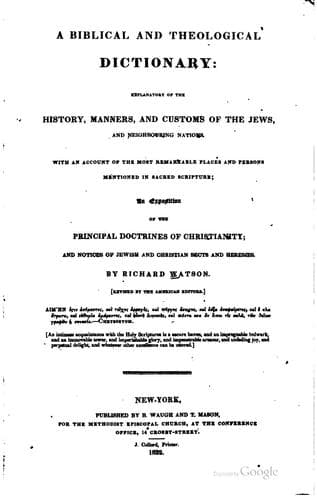
A Biblical and Theological Dictionary: explanatory of the history, manners, and customs of the Jews, and neighbouring nationsWatson, Richard
Religion
A Biblical and Theological Dictionary: explanatory of the history, manners, and customs of the Jews, and neighbouring nations
Watson, Richard
Bible -- Dictionaries; Theology -- Dictionaries
as well as other nations.” It is farther argued, that God, by the
Prophet Amos, in the reign of Jeroboam, about ten or twenty years before
the reign of Pul, (see Amos vi, 13, 14,) threatened to raise up a nation
against Israel; and that, as Pul reigned presently after the prophecy of
Amos, and was the first upon record who began to fulfil it, he may be
justly reckoned the first conqueror and founder of this empire. See 1
Chron. v, 26. Pul was succeeded on the throne of Assyria by his elder
son Tiglath-pileser; and at the same time he left Babylon to his younger
son Nabonassar, B. C. 747. Of the conquests of this second king of
Assyria against the kings of Israel and Syria, when he took Damascus,
and subdued the Syrians, we have an account in 2 Kings xv, 29, 37; xvi,
5,9; 1 Chron. v, 26; by which the prophecy of Amos was fulfilled, and
from which it appears that the empire of the Assyrians was now become
great and powerful. The next king of Assyria was Shalmaneser, or
Salmanassar, who succeeded Tiglath-pileser, B. C. 729, and invaded
Phœnicia, took the city of Samaria, and, B. C. 721, carried the ten
tribes into captivity, placing them in Chalach and Chabor, by the river
Gazon, and in the cities of the Medes, 2 Kings xvii, 6. Shalmaneser was
succeeded by Sennacherib, B. C. 719; and in the year B. C. 714, he was
put to flight with great slaughter by the Ethiopians and Egyptians. In
the year B. C. 711 the Medes revolted from the Assyrians; Sennacherib
was slain; and he was succeeded by his son Esar-Haddon, Asserhaddon,
Asordan, Assaradin, or Sarchedon, by which names he is called by
different writers. He began his reign at Nineveh, in the year of
Nabonassar 42; and in the year 68 extended it over Babylon. He then
carried the remainder of the Samaritans into captivity, and peopled
Samaria with captives brought from several parts of his kingdom; and in
the year of Nabonassar 77 or 78 he seems to have put an end to the reign
of the Ethiopians over Egypt. “In the reign of Sennacherib and
Asser-Hadon,” says Sir I. Newton, “the Assyrian empire seems arrived at
its greatness; being united under one monarch, and containing Assyria,
Media, Apolloniatis, Susiana, Chaldea, Mesopotamia, Cilicia, Syria,
Phœnicia, Egypt, Ethiopia, and part of Arabia; and reaching eastward
into Elymais, and Parætæcene, a province of the Medes; and if Chalach
and Chabor be Colchis and Iberia, as some think, and as may seem
probable from the circumcision used by those nations till the days of
Herodotus, we are also to add these two provinces, with the two
Armenias, Pontus, and Cappadocia, as far as to the river Halys: for
Herodotus tells us that the people of Cappadocia, as far as to that
river, were called Syrians by the Greeks, both before and after the days
of Cyrus; and that the Assyrians were also called Syrians by the
Greeks.” Asser-Hadon was succeeded in the year B. C. 668 by
Saosduchinus. At this time Manasseh was allowed to return home, and
Public-domain text, read in full here on John Shaqi.
Reviews
Reviews
No reviews yet
Be the first to share your thoughts on this work.
Elsewhere in the archive
Join the Discussion
Join the discussion
Sign in to leave a comment or review.
Sign InorCreate an account