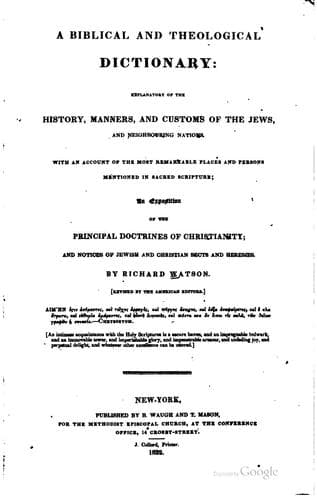
A Biblical and Theological Dictionary: explanatory of the history, manners, and customs of the Jews, and neighbouring nationsWatson, Richard
Religion
A Biblical and Theological Dictionary: explanatory of the history, manners, and customs of the Jews, and neighbouring nations
Watson, Richard
Bible -- Dictionaries; Theology -- Dictionaries
fortify Jerusalem; and the Egyptians also, after the Assyrians had
harassed Egypt and Ethiopia three years, Isa. xx, 3, 4, were set at
liberty. Saosduchinus, after a reign of twenty years, was succeeded at
Babylon, and probably at Nineveh also, by Chyniladon, in the year B. C.
647. This Chyniladon is supposed by Newton to be the Nebuchadonosor
mentioned in the book of Judith, i, 1–15, who made war upon Arphaxad,
king of the Medes; and, though deserted by his auxiliaries of Cilicia,
Damascus, Syria, Phœnicia, Moab, Ammon, and Egypt, routed the army of
the Medes, and slew Arphaxad. This Arphaxad is supposed to be either
Dejoces or his son Phraortes, mentioned by Herodotus. Soon after the
death of Phraortes, in the year B. C. 635, the Scythians invaded the
Medes and Persians; and in 625, Nabopolassar, the commander of the
forces of Chyniladon in Chaldea, revolted from him, and became king of
Babylon. Chyniladon was either then or soon after succeeded at Nineveh
by the last king of Assyria, called Sarac by Polyhistor. The authors of
the Universal History suppose Saosduchinus to have been the
Nebuchadonosor of Scripture, and Chyniladon or Chynaladan to have been
the Sarac of Polyhistor. At length Nebuchadnezzar, the son of
Nabopolassar, married Amyit, the daughter of Astyages, king of the
Medes, and sister of Cyaxares; and by this marriage the two families
having contracted affinity, they conspired against the Assyrians.
Nabopolassar being old, and Astyages dead, their sons Nebuchadnezzar and
Cyaxares led the armies of the two nations against Nineveh, slew Sarac,
destroyed the city, and shared the kingdom of the Assyrians. This
victory the Jews refer to the Chaldeans; the Greeks, to the Medes;
Tobit, xiv, 15, Polyhistor, and Ctesias, to both. With this victory
commenced the great successes of Nebuchadnezzar and Cyaxares, and it
laid the foundation of the two collateral empires of the Babylonians and
Medes, which were branches of the Assyrian empire; and hence the time of
the fall of the Assyrian empire is determined, the conquerors being then
in their youth. In the reign of Josiah, when Zephaniah prophesied,
Nineveh and the kingdom of Assyria were standing; and their fall was
predicted by that Prophet, Zeph. i, 3; ii, 13. And in the end of his
reign, Pharaoh-Necho, king of Egypt, the successor of Psammitichus, went
up against the king of Assyria to the river Euphrates, to fight against
Carchemish, or Circutium; and in his way thither slew Josiah, 2 Kings
xxiii, 29; 2 Chron. xxxv, 20; and therefore the last king of Assyria was
not yet slain. But in the third and fourth years of Jehoiakim, the
successor of Josiah, the two conquerors having taken Nineveh, and
finished their war in Assyria, prosecuted their conquests westward; and,
leading their forces against the king of Egypt, as an invader of their
right of conquest, they beat him at Carchemish, and took from him
whatever he had recently taken from the Assyrians, 2 Kings xxiv, 7; Jer.
Public-domain text, read in full here on John Shaqi.
Reviews
Reviews
No reviews yet
Be the first to share your thoughts on this work.
Elsewhere in the archive
Join the Discussion
Join the discussion
Sign in to leave a comment or review.
Sign InorCreate an account