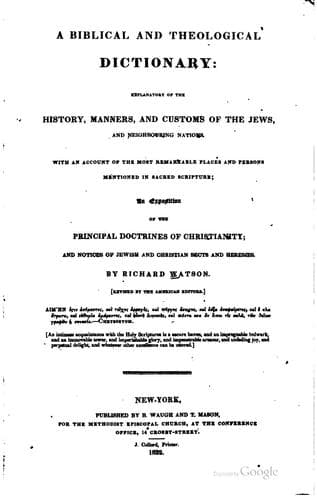
A Biblical and Theological Dictionary: explanatory of the history, manners, and customs of the Jews, and neighbouring nationsWatson, Richard
Religion
A Biblical and Theological Dictionary: explanatory of the history, manners, and customs of the Jews, and neighbouring nations
Watson, Richard
Bible -- Dictionaries; Theology -- Dictionaries
dissolved, as in the case of forgiveness by the exercise of mere
prerogative; but if an arbitrary selection be made, then different and
discordant principles of government are introduced into the divine
administration, which is a derogatory supposition.
The question proposed abstractedly, How may mercy be extended to
offending creatures, the subjects of the divine government, without
encouraging vice, by lowering the righteous and holy character of God,
and the authority of his government, in the maintenance of which the
whole universe of beings are interested? is, therefore, at once one of
the most important and one of the most difficult that can employ the
human mind. None of the theories which have been opposed to Christianity
affords a satisfactory solution of the problem. They assume principles
either destructive of moral government, or which cannot, in the
circumstances of man, be acted upon. The only answer is found in the
Holy Scriptures. They alone show, and, indeed, they alone profess to
show, how God may be “just,” and yet the “justifier” of the ungodly.
Other schemes show how he may be merciful; but the difficulty does not
lie there. The Gospel meets it, by declaring “the righteousness of God,”
at the same time that it proclaims his mercy. The voluntary sufferings
of the Divine Son of God “for us,” that is, in our room and stead,
magnify the justice of God; display his hatred to sin; proclaim “the
exceeding sinfulness” of transgression, by the deep and painful manner
in which they were inflicted upon the Substitute; warn the persevering
offender of the terribleness, as well as the certainty, of his
punishment; and open the gates of salvation to every penitent. It is a
part of the same divine plan also to engage the influence of the Holy
Spirit, to awaken penitence in man, and to lead the wanderer back to
himself; to renew our fallen nature in righteousness, at the moment we
are justified through faith, and to place us in circumstances in which
we may henceforth “walk not after the flesh, but after the Spirit.” All
the ends of government are here answered--no license is given to
offence,--the moral law is unrepealed,--a day of judgment is still
appointed,--future and eternal punishments still display their awful
sanctions,--a new and singular display of the awful purity of the divine
character is afforded,--yet pardon is offered to all who seek it; and
the whole world may be saved.
Public-domain text, read in full here on John Shaqi.
Reviews
Reviews
No reviews yet
Be the first to share your thoughts on this work.
Elsewhere in the archive
Join the Discussion
Join the discussion
Sign in to leave a comment or review.
Sign InorCreate an account