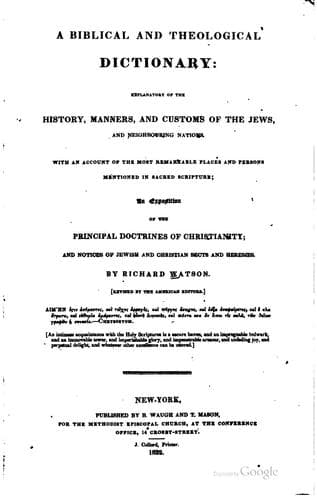
A Biblical and Theological Dictionary: explanatory of the history, manners, and customs of the Jews, and neighbouring nationsWatson, Richard
Religion
A Biblical and Theological Dictionary: explanatory of the history, manners, and customs of the Jews, and neighbouring nations
Watson, Richard
Bible -- Dictionaries; Theology -- Dictionaries
With such evidence of suitableness to the case of mankind, under such
lofty views of connection with the principles and ends of moral
government, does the doctrine of the atonement present itself. But other
important considerations are not wanting to mark the united wisdom and
goodness of that method of extending mercy to the guilty, which
Christianity teaches us to have been actually and exclusively adopted.
It is rendered, indeed, “worthy of all acceptation,” by the circumstance
of its meeting the difficulties we have just dwelt upon,--difficulties
which could not otherwise have failed to make a gloomy impression upon
every offender awakened to a sense of his spiritual danger; but it must
be very inattentively considered, if it does not farther commend itself
to us, by not only removing the apprehensions we might feel as to the
severity of the divine Lawgiver, but as exalting him in our esteem as
“the righteous Lord, who loveth righteousness,” who surrendered his
beloved Son to suffering and death, that the influence of moral goodness
might not be weakened in the hearts of his creatures; and as a God of
love, affording in this instance a view of the tenderness and benignity
of his nature infinitely more impressive and affecting than any abstract
description could convey, or than any act of creating and providential
power and grace could exhibit, and, therefore, most suitable to subdue
that enmity which had unnaturally grown up in the hearts of his
creatures, and which, when corrupt, they so easily transfer from a law
which restrains their inclination to the Lawgiver himself. If it be
important to us to know the extent and reality of our danger, by the
death of Christ it is displayed, not in description, but in the most
impressive action; if it be important that we should have an assurance
of the divine placability toward us, it here receives a demonstration
incapable of being heightened; if gratitude be the most powerful motive
of future obedience, and one which renders command on the one part, and
active service on the other, “not grievous but joyous,” the recollection
of such obligations as those which the “love of Christ” has laid us
under, is a perpetual spring to this energetic affection, and will be
the means of raising it to higher and more delightful activity for ever.
All that can most powerfully illustrate the united tenderness and awful
majesty of God, and the odiousness of sin; all that can win back the
heart of man to his Maker and Lord, and render future obedience a matter
of affection and delight as well as duty; all that can extinguish the
angry and malignant passions of man to man; all that can inspire a
mutual benevolence, and dispose to a self-denying charity for the
benefit of others; all that can arouse by hope, or tranquillize by
faith; is to be found in the vicarious death of Christ, and the
principles and purposes for which it was endured.
Public-domain text, read in full here on John Shaqi.
Reviews
Reviews
No reviews yet
Be the first to share your thoughts on this work.
Elsewhere in the archive
Join the Discussion
Join the discussion
Sign in to leave a comment or review.
Sign InorCreate an account