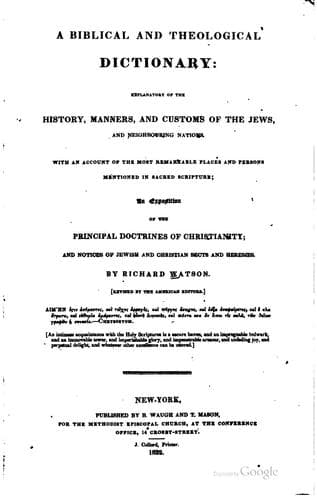
A Biblical and Theological Dictionary: explanatory of the history, manners, and customs of the Jews, and neighbouring nationsWatson, Richard
Religion
A Biblical and Theological Dictionary: explanatory of the history, manners, and customs of the Jews, and neighbouring nations
Watson, Richard
Bible -- Dictionaries; Theology -- Dictionaries
was an exercise of the will combined with the workings of grace. In the
tenth chapter of his work against the Manichæans, the bishop of Hippo
thus expresses himself: ‘Who is it that will not exclaim, _How foolish
it is to deliver precepts to that man who is not at liberty to perform
what is commanded! And how unjust it is to condemn him who had not power
to fulfil the commands!_ Yet these unhappy persons [the Manichees] do
not perceive that they are ascribing such injustice and want of equity
to God. But what greater truth is there than this, that God has
delivered precepts, and that human spirits have freedom of will?‘
Elsewhere he says, ‘Nothing is more within our power than our own will.
The will is that by which we commit sin, and by which we live
righteously.’ Nothing can be plainer than that the writer of these
passages admitted the liberty of the human will, and the necessity of
our own exertions in conjunction with divine grace. How this is to be
reconciled with his general doctrine, is perhaps indicated in the
following passage from his book _De Gratiâ et lib. Arbitrio, c. 17_.
Speaking of grace he says, ‘That we may _will_ God _works_ without us;
but when we _will_, and so _will_ as to _do_, he _co-works_ with us; yet
unless he either _works_ that we may will, or _co-works_ when we do
will, we are utterly incapable of doing any thing in the good works of
piety.’” These are but very slight specimens of the mode in which
learned and ingenious men have tried to give a kind of symmetrical
proportion to this father’s doctrinal system. Several large treatises
have been published with the same praiseworthy intention; the pious
authors of them either entirely forgetting, or having never read, the
rather latitudinarian indulgence of opinion which St. Augustine claims
for himself in his “Retractations,” in which he has qualified the
harshness of his previous assertions on many subjects. If, however, an
estimate may be formed of what this father intended in his various
pacifacatory doctrinal explanations from what he has actually admitted
and expressed, it may be safely affirmed that no systematic writer of
theology seems so completely to have entered into the last and best
views of the bishop of Hippo, or so nearly reconciled the apparent
discordances in them, as Arminius has done; and few other authors have
rendered more ample justice to his sentiments, talents, and character,
than the famous Dutch Professor.
Public-domain text, read in full here on John Shaqi.
Reviews
Reviews
No reviews yet
Be the first to share your thoughts on this work.
Elsewhere in the archive
Join the Discussion
Join the discussion
Sign in to leave a comment or review.
Sign InorCreate an account