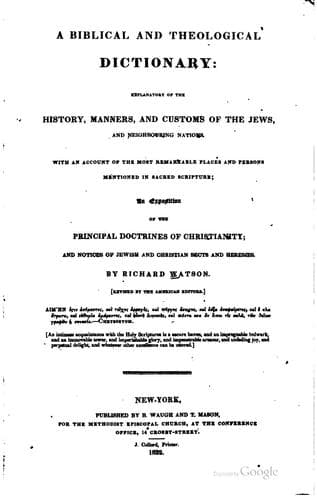
A Biblical and Theological Dictionary: explanatory of the history, manners, and customs of the Jews, and neighbouring nationsWatson, Richard
Religion
A Biblical and Theological Dictionary: explanatory of the history, manners, and customs of the Jews, and neighbouring nations
Watson, Richard
Bible -- Dictionaries; Theology -- Dictionaries
Many were the theological labours to which he was invited by the most
eminent of his contemporaries; and hastily as some of his lucubrations
were executed, it is not surprising that among two hundred and
seventy-two treatises on different subjects, some are of inferior value
and unworthy of the fame which he had acquired in the church. After a
life of various changes, and of a mixed character, he died A. D. 430, in
the seventy-sixth year of his age; having been harassed at the close of
life by seeing his country invaded by the Vandals, and the city of which
he was the bishop besieged. Though those barbarians took Hippo and
burned it, they saved his library, which contained his voluminous
writings.
St. Augustine was a diligent man in the sacred calling; and that the
office of a bishop even in that age of the church was no sinecure, is
evident from several notices in his letters. At the close of one
addressed to Marcellinus he gives the subjoined account: “If I were able
to give you a narrative of the manner in which I spend my time, you
would be both surprised and distressed on account of the great number of
affairs which oppress me without my being able to suspend them. For when
some little leisure is allowed me by those who daily attend upon me
about business, and who are so urgent with me that I can neither shun
them nor ought to despise them, I have always some other writings to
compose, which indeed ought to be preferred, [to those which Marcellinus
requested,] because the present juncture will not permit them to be
postponed. For the rule of charity is, not to consider the greatness of
the friendship, but the necessity of the affair. Thus I have continually
something or other to compose which diverts me from writing what would
be more agreeable to my inclinations, daring the little intervals in
that multiplicity of business with which I am burdened either through
the wants or the passions of others.” He frequently complains of this
oppressive weight of occupation in which his love of his flock had
engaged him, by obeying the Apostolical precept, which forbids
Christians from going to law before Pagan tribunals. In reference to
this employment his biographer, Posidonius, says: “At the desire of
Christians, or of men belonging to any sect whatever, he would hear
causes with patience and attention, sometimes till the usual hour of
eating, and sometimes the whole day without eating at all, observing the
dispositions of the parties, and how much they advanced or decreased in
faith and good works; and when he had opportunity he instructed them in
the law of God, and gave them suitable advice, requiring nothing of them
except Christian obedience. He sometimes wrote letters, when desired, on
temporal subjects; but looked upon all this as unprofitable occupation,
which drew him aside from that which was better and more agreeable to
himself.”
Public-domain text, read in full here on John Shaqi.
Reviews
Reviews
No reviews yet
Be the first to share your thoughts on this work.
Elsewhere in the archive
Join the Discussion
Join the discussion
Sign in to leave a comment or review.
Sign InorCreate an account