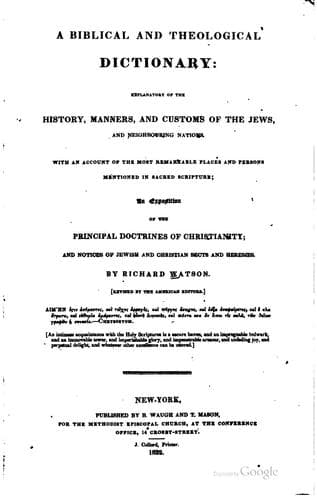
A Biblical and Theological Dictionary: explanatory of the history, manners, and customs of the Jews, and neighbouring nationsWatson, Richard
Religion
A Biblical and Theological Dictionary: explanatory of the history, manners, and customs of the Jews, and neighbouring nations
Watson, Richard
Bible -- Dictionaries; Theology -- Dictionaries
7. Sarah having conceived, according to the divine promise, Abraham left
the plain of Mamre, and went south to Gerar, where Abimelech reigned;
and again fearing lest Sarah should be forced from him, and himself be
put to death, her beauty having been, it would appear, preternaturally
continued, notwithstanding her age, he here called her, as he had done
in Egypt, his sister. Abimelech took her to his house, designing to
marry her; but God having, in a dream, informed him that she was
Abraham’s wife, he returned her to him with great presents. This year
Sarah was delivered of Isaac; and Abraham circumcised him, according to
the covenant stipulation; and when he was weaned, made a great
entertainment. Sarah, having observed Ishmael, son of Hagar, mocking her
son Isaac, said to Abraham, “Cast out this bondwoman and her son, for
Ishmael shall not be heir with Isaac.” After great reluctance, Abraham
complied; God having informed him that this was according to the
appointments of his providence, with respect to future ages. About the
same time, Abimelech came with Phicol, his general, to conclude an
alliance with Abraham, who made that prince a present of seven ewe lambs
out of his flock, in confirmation that a well he had opened should be
his own property; and they called the place Beer-sheba, or “the well of
swearing,” because of the covenant there ratified with oaths. Here
Abraham planted a grove, built an altar, and for some time resided, Gen.
xx, xxi.
8. More than twenty years after this, (A. M. 2133,) God, for the final
trial and illustration of Abraham’s faith, directed him to offer up his
son Isaac. Abraham took his son, and two servants, and went toward mount
Moriah. When within sight of the mountain, Abraham left his servants,
and ascended it with his son only; and there having bound him, he
prepared for the affecting sacrifice; but when he was about to give the
blow, an angel from heaven cried out to him, “Lay not thine hand upon
the lad, neither do thou any thing to him. Now I know that thou fearest
God, since thou hast not withheld thine only son from me.” Abraham,
turning, saw a ram entangled in the bush by his horns; and he offered
this animal as a burnt offering, instead of his son Isaac. This
memorable place he called by the prophetic name, _Jehovah-jireh_, or
_the Lord will see_--or _provide_, Gen. xxii, 1–14, having respect, no
doubt, to the true sacrifice which, in the fulness of time, was to be
offered for the whole world upon the same mountain.
Public-domain text, read in full here on John Shaqi.
Reviews
Reviews
No reviews yet
Be the first to share your thoughts on this work.
Join the Discussion
Join the discussion
Sign in to leave a comment or review.
Sign InorCreate an account