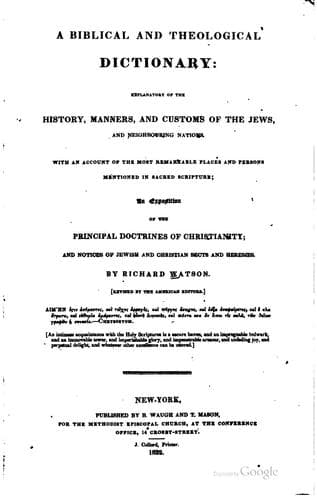
A Biblical and Theological Dictionary: explanatory of the history, manners, and customs of the Jews, and neighbouring nationsWatson, Richard
Religion
A Biblical and Theological Dictionary: explanatory of the history, manners, and customs of the Jews, and neighbouring nations
Watson, Richard
Bible -- Dictionaries; Theology -- Dictionaries
5. After this he had another encouraging vision of God, Gen. xv, 1; and
to his complaint that he was still childless, and that his name and
property would descend to the stranger Eliezer, who held the next rank
in his tribe, the promise was given, that he himself should have a son,
and that his seed should be countless as the stars of heaven. And it is
emphatically added, “He believed in the Lord, and he counted it to him
for righteousness.” He was then fully assured, that he stood before God,
a pardoned and accepted man, “whose iniquities were forgiven,” and to
whom “the Lord did not impute sin.” Still the fulfilment of the promise
of a son was delayed; and Sarah, perhaps despairing that it would be
accomplished in her person, and the revelation which had been made
merely stating that this son should be the fruit of Abraham’s body,
without any reference to her, she gave to him, according to the custom
of those times, one of her handmaids, an Egyptian, to be his secondary
wife, who brought forth Ishmael. Children born in this manner had the
privileges of legitimacy; but fourteen years afterward, when Abraham was
a hundred years old, and Sarah ninety, the Lord appeared to him again,
established his covenant with him and with his seed, changed his name to
Abraham, “the father of many nations,” promised that Sarah herself
should bring forth the son to whom the preceding promises had referred;
instituted circumcision as the sign of the covenant; and changed the
name of his wife from Sarai, _my princess_, to Sarah, _the princess_,
that is, of many people to descend from her.
6. At this time Abraham occupied his former encampment near Hebron.
Here, as he sat in the door of his tent, three mysterious strangers
appeared. Abraham, with true Arabian hospitality, received and
entertained them. The chief of the three renewed the promise of a son to
be born from Sarah, a promise which she received with a laugh of
incredulity, for which she was mildly reproved. As Abraham accompanied
them toward the valley of the Jordan, the same divine person, for so he
manifestly appears, announced the dreadful ruin impending over the
licentious cities among which Lot had taken up his abode. No passage,
even in the sacred writings, exhibits a more exalted view of the divine
condescension than that in which Abraham is seen expostulating on the
apparent injustice of involving the innocent in the ruin of the guilty:
“Shall the city perish, if fifty, if forty-five, if forty, if thirty, if
twenty, if ten righteous men be found within its walls?” “Ten righteous
men shall avert its doom.” Such was the promise of the celestial
visitant; but the guilt was universal, the ruin inevitable; and the
violation of the sacred laws of hospitality and nature, which Lot in his
horror attempted to avert by the most revolting expedient, confirmed the
justice of the divine sentence.
Public-domain text, read in full here on John Shaqi.
Reviews
Reviews
No reviews yet
Be the first to share your thoughts on this work.
Join the Discussion
Join the discussion
Sign in to leave a comment or review.
Sign InorCreate an account