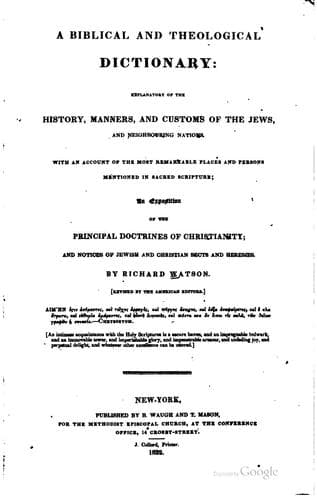
A Biblical and Theological Dictionary: explanatory of the history, manners, and customs of the Jews, and neighbouring nationsWatson, Richard
Religion
A Biblical and Theological Dictionary: explanatory of the history, manners, and customs of the Jews, and neighbouring nations
Watson, Richard
Bible -- Dictionaries; Theology -- Dictionaries
There were many cities in Palestine, whose names were compounded of
_Baal_ and some other word: whether it was that the god Baal was adored
in them, or that these places were looked upon as the capital
cities,--_lords_ of their respective provinces,--is uncertain.
BAAL BERITH, the god of the Shechemites, Judges viii, 33; ix, 4, 46.
BAAL PEOR. Peor is supposed to have been a part of Mount Abarim; and
Baal was the great idol or chief god of the Phœnicians, and was known
and worshipped under a similar name, with tumultuous and obscene rites,
all over Asia. He is the same as the Bel of the Babylonians. Baal, by
itself, signifies _lord_, and was a name of the solar or principal god.
But it was also variously compounded, in allusion to the different
characters and attributes of the particular or local deities who were
known by it, as Baal Peor, Baal Zebub, Baal Zephon, &c. Baal Peor, then,
was probably the temple of an idol belonging to the Moabites, on Mount
Abarim, which the Israelites worshipped when encamped at Shittim; this
brought a plague upon them, of which twenty-four thousand died, Num.
xxxv. Chemosh, the abomination of Moab, to whom Solomon erected an
altar, 1 Kings xi, 7, is supposed to have been the same deity. Baal Peor
has been farther supposed by some to have been Priapus; by others,
Saturn; by others, Pluto; and by others again, Adonis. Mr. Faber agrees
with Calmet in making Baal Peor the same with Adonis; a part of whose
worship consisted in bewailing him with funeral rites, as one lost or
dead, and afterward welcoming, with extravagant joy, his fictitious
return to life. He was in an eminent degree the god of impurity. Hosea,
speaking of the worship of this idol, emphatically calls it “that
shame,” Hos. ix, 10. Yet in the rites of this deity the Moabite and
Midianite women seduced the Israelites to join.
BAAL ZEBUB, BEELZEBUB, or BEL-ZEBUB, signifies the _god of flies_, and
was an idol of the Ekronites. It is not easy to discover how this false
deity obtained its name. Some commentators think that he was called Baal
Samin, or the lord of heaven; but that the Jews, from contempt, gave him
the name of Baal-zebub. Others with greater reason believe that he was
denominated “the god of flies” by his votaries, because he defended them
from flies, which are extremely troublesome in hot countries; in the
same manner as the Eleans worshipped Hercules under the appellation of
Ἀπόμυιος, _the fly chaser_. Pliny is of opinion, that the name of Achor,
the god invoked at Cyrene against flies, is derived from Accaron, or
Ekron, where Baal-zebub was worshipped, and where he had a famous temple
and oracle. Winkelman has given the figures of two heads, “both of them
images of Jupiter, called by the Greeks Ἀπόμυιος, and by the Romans
_Muscarius_; that is to say, _fly driver_; for to this Jupiter was
attributed the function of driving away flies.”
Public-domain text, read in full here on John Shaqi.
Reviews
Reviews
No reviews yet
Be the first to share your thoughts on this work.
Elsewhere in the archive
Join the Discussion
Join the discussion
Sign in to leave a comment or review.
Sign InorCreate an account