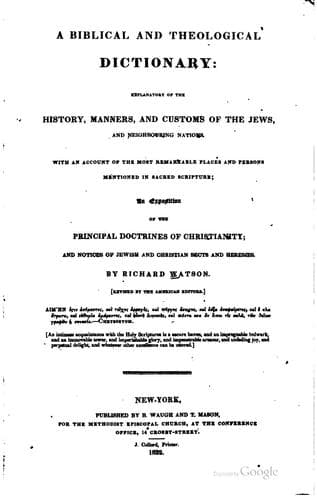
A Biblical and Theological Dictionary: explanatory of the history, manners, and customs of the Jews, and neighbouring nationsWatson, Richard
Religion
A Biblical and Theological Dictionary: explanatory of the history, manners, and customs of the Jews, and neighbouring nations
Watson, Richard
Bible -- Dictionaries; Theology -- Dictionaries
It is evident that Beelzebub was considered as the patron deity of
medicine; for this is plainly implied in the conduct of Ahaziah, 2 Kings
i. The Greek mythology considered Apollo as the god of medicine, and
attributed also to him those possessions by a pythonic spirit which
occasionally perplexed spectators, and of which we have an instance in
Acts xvi, 19. Apollo, too, was the sun. Hence we probably see the reason
why Ahaziah sent to Beelzebub to inquire the issue of his accident;
since Beelzebub was Apollo, and Apollo was the god of physic. The Jews,
who changed _Beelzebub_ into _Beelzebul_, “god of a dunghill,” perhaps
had a reference to the Greek of _pytho_, which signifies _putrefied_. In
Scripture Beelzebub is called “the prince of devils,” Matt. xii, 24;
Luke xi, 15; merely, it would seem, through the application of the name
of the chief idol of the Heathen world to the prince of evil spirits.
This was natural, since the Jews were taught in their own Scriptures to
consider all the idols of the Heathens “devils.” Those commentators who
think that the idol of Ekron himself is intended, have indulged in an
improbable fancy. See HORNET.
BAAL ZEPHON, or _the god of the watch tower_, was probably the temple of
some idol, which served at the same time for a place of observation for
the neighbouring sea and country, and a beacon to the travellers by
either. It was situated on a cape or promontory on the eastern side of
the western or Heroopolitan branch of the Red Sea, near its northern
extremity, over against Pihahiroth, or the opening in the mountains
which led from the desert, on the side of Egypt, to the Red Sea.
BAASHA, the son of Ahijah, commander-in-chief of the armies belonging to
Nadab, the son of Jeroboam, king of Israel. Baasha killed his master
treacherously at the siege of Gibbethon, a city of the Philistines, A.
M. 3051, and usurped the crown, which he possessed twenty-four years, 1
Kings xv, 27, &c. And, to secure himself in his usurpation, he massacred
all the relatives of his predecessor; which barbarous action proved the
accomplishment of the prophecy denounced against the house of Jeroboam
by Ahijah, the prophet, 1 Kings xiv, 1, &c.
Public-domain text, read in full here on John Shaqi.
Reviews
Reviews
No reviews yet
Be the first to share your thoughts on this work.
Elsewhere in the archive
Join the Discussion
Join the discussion
Sign in to leave a comment or review.
Sign InorCreate an account