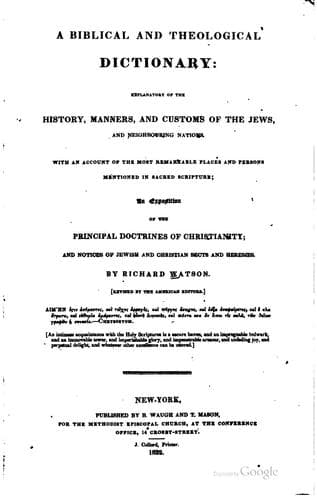
A Biblical and Theological Dictionary: explanatory of the history, manners, and customs of the Jews, and neighbouring nationsWatson, Richard
Religion
A Biblical and Theological Dictionary: explanatory of the history, manners, and customs of the Jews, and neighbouring nations
Watson, Richard
Bible -- Dictionaries; Theology -- Dictionaries
devotions were performed; and over this, on the highest platform of all,
was the observatory, by the help of which the Babylonians arrived to
such perfection in astronomy, that Calisthenes the philosopher, who
accompanied Alexander to Babylon, found astronomical observations for
1903 years backwards from that time; which reach as high as the 115th
year after the flood. On either side of the river, according to
Diodorus, adjoining to the bridge, was a palace; that on the western
bank being by much the larger. This palace was eight miles in
circumference, and strongly fortified with three walls one within
another. Within it were the celebrated pensile or hanging gardens,
enclosed in a square of 400 feet. These gardens were raised on terraces,
supported by arches, or rather by piers, laid over with broad flat
stones; the arch appearing to be unknown to the Babylonians: which
courses of piers rose above one another, till they reached the level of
the top of the city walls. On each terrace or platform, a deep layer of
mould was laid, in which flowers, shrubs and trees were planted; some of
which are said to have reached the height of 50 feet. On the highest
level was a reservoir, with an engine to draw water up from the river by
which the whole was watered. This novel and astonishing structure, the
work of a monarch who knew not how to create food for his own pampered
fancy, or labour for his debased subjects or unhappy captives, was
undertaken to please his wife Amyitis; that she might see an imitation
of the hills and woods of her native country, Media.
Yet, while in the plenitude of its power, and, according to the most
accurate chronologers, 160 years before the foot of an enemy had entered
it, the voice of an enemy had entered it, the voice of prophecy
pronounced the doom of the mighty and unconquered Babylon. A succession
of ages brought it gradually to the dust; and the gradation of its fall
is marked till it sinks at last into utter desolation. At a time when
nothing but magnificence was around this city, emphatically called the
great, fallen Babylon was delineated by the pencil of inspiration
exactly as every traveller now describes its ruins.
Public-domain text, read in full here on John Shaqi.
Reviews
Reviews
No reviews yet
Be the first to share your thoughts on this work.
Elsewhere in the archive
Join the Discussion
Join the discussion
Sign in to leave a comment or review.
Sign InorCreate an account