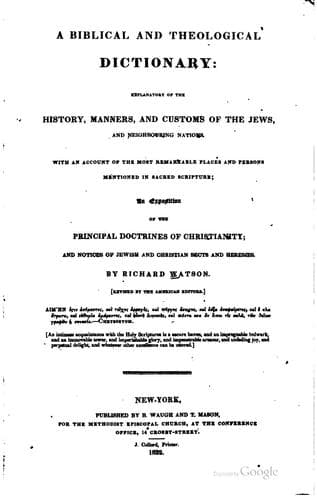
A Biblical and Theological Dictionary: explanatory of the history, manners, and customs of the Jews, and neighbouring nationsWatson, Richard
Religion
A Biblical and Theological Dictionary: explanatory of the history, manners, and customs of the Jews, and neighbouring nations
Watson, Richard
Bible -- Dictionaries; Theology -- Dictionaries
stood before the palace gates, and two thousand on each side. These
advanced as Cyrus approached; two thousand spearmen followed them. These
were succeeded by four square masses of Persian cavalry, each consisting
of ten thousand men: and to these again were added, in their order, the
Median, Armenian, Hyrcanian, Caducian, and Sacian horsemen,--all, as
before, “riding upon horses, every man in array,”--with lines of
chariots, four abreast, concluding the train of the numerous hosts.
Cyrus afterward reviewed, at Babylon, the whole of his army, consisting
of one hundred and twenty thousand horse, two thousand chariots, and six
hundred thousand foot. Babylon, which was taken when not aware, and
within whose walls no enemy, except a captive, had been ever seen, was
thus “filled with men as with caterpillars,” as if there had not been a
wall around it. The Scriptures do not relate the manner in which Babylon
was taken, nor do they ever allude to the exact fulfilment of the
prophecies. But there is, in every particular, a strict coincidence
between the predictions of the prophets and the historical narratives,
both of Herodotus and Xenophon.
3. Every step in the progress of the decline of Babylon was the
accomplishment of a prophecy. Conquered, for the first time, by Cyrus,
it was afterward reduced from an imperial to a tributary city. “Come
down and sit in the dust, O daughter of Babylon: sit on the ground,
there is no throne, O daughter of the Chaldeans.” After the Babylonians
rebelled against Darius, the walls were reduced in height, and all the
gates destroyed. “The wall of Babylon shall fall, her walls are thrown
down.”--Xerxes, after his ignominious retreat from Greece, rifled the
temples of Babylon, the golden images alone of which were estimated at
20,000,000_l_, beside treasures of vast amount. “I will punish Bel in
Babylon, and I will bring forth out of his mouth that which he has
swallowed up; I will do judgment upon the graven images of
Babylon.”--Alexander the Great attempted to restore it to its former
glory, and designed to make it the metropolis of a universal empire. But
while the building of the temple of Belus, and the reparation of the
embankments of the Euphrates, were actually carrying on, the conqueror
of the world died, at the commencement of this his last undertaking, in
the height of his power, and in the flower of his age. “Take balm for
her pain, if so be that she may be healed. We would have healed Babylon,
but she is not healed.” The building of the neighbouring city of
Seleucia was the chief cause of the decline of Babylon, and drained it
of a great part of its population. And at a later period, or about 130
years before the birth of Christ, Humerus, a Parthian governor, who was
noted as excelling all tyrants in cruelty, exercised great severities on
the Babylonians; and having burned the forum and some of the temples,
and destroyed the fairest parts of the city, reduced many of the
Public-domain text, read in full here on John Shaqi.
Reviews
Reviews
No reviews yet
Be the first to share your thoughts on this work.
Elsewhere in the archive
Join the Discussion
Join the discussion
Sign in to leave a comment or review.
Sign InorCreate an account