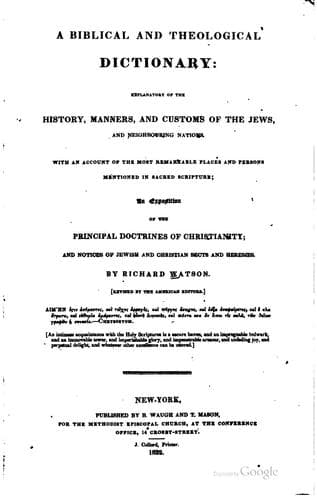
A Biblical and Theological Dictionary: explanatory of the history, manners, and customs of the Jews, and neighbouring nationsWatson, Richard
Religion
A Biblical and Theological Dictionary: explanatory of the history, manners, and customs of the Jews, and neighbouring nations
Watson, Richard
Bible -- Dictionaries; Theology -- Dictionaries
inhabitants to slavery on the slightest pretexts, and caused them,
together with all their households, to be sent into Media. “They shall
remove, they shall depart, both man and beast.” The “golden city” thus
gradually verged, for centuries, toward poverty and desolation.
Notwithstanding that Cyrus resided chiefly at Babylon, and sought to
reform the government, and remodel the manners of the Babylonians, the
succeeding kings of Persia preferred, as the seat of empire, Susa,
Persepolis, or Ecbatana, situated in their own country: and in like
manner the successors of Alexander did not attempt to complete his
purpose of restoring Babylon to its preeminence and glory; but, after
the subdivision of his mighty empire, the very kings of Assyria, during
their temporary residence even in Chaldea, deserted Babylon, and dwelt
in Seleucia. And thus the foreign inhabitants, first Persians and
afterward Greeks, imitating their sovereigns by deserting Babylon, acted
as if they verily had said, “Forsake her, and let us go every man unto
his own country; for her judgment is reached unto heaven, and is lifted
up even to the skies.”
4. But kindred judgments, the issue of common crimes, rested on the land
of Chaldea, as well as on its doomed metropolis. “They come from a far
country, from the end of the earth, to destroy the whole land. Many
nations and great kings shall serve themselves of thee also,” &c. The
Persians, the Macedonians, the Parthians, the Romans, the Saracens, and
the Turks, are the chief of the many nations who have unscrupulously and
unsparingly “served themselves” of the land of the Chaldeans: and Cyrus
and Darius, kings of Persia; Alexander the Great; and Seleucus, king of
Assyria; Demetrius and Antiochus the Great; Tragan, Severus, Julian, and
Heraclius, emperors of Rome; the victorious Omar, the successor of
Mohammed; Holagou, and Tamerlane,--are “great kings” who successively
subdued or desolated Chaldea, or exacted from it tribute to such an
extent, as scarcely any other country ever paid to a single conqueror.
And though the names of some of these nations were unknown to the
Babylonians, and unheard of in the world at the time of the prophecy,
most of these “many nations and great kings” need now but to be named,
to show that, in local relation to Chaldea, “they came from the utmost
border, from the coasts of the earth.”--“I will punish the land of the
Chaldeans, and will make it perpetual desolations; cut off the sower
from Babylon, and him that handleth the sickle in the time of harvest. A
drought is on her waters, and they shall be dried up. Behold the
hinder-most of the nations, a dry land and a desert.” The land of the
Chaldeans was indeed made--perpetual, or long continued, desolation.
Ravaged and spoiled for ages, the Chaldees’ excellency finally
disappeared, and the land became desolate, as still it remains.
Rauwolff, who passed through it in 1574, describes the country as bare,
Public-domain text, read in full here on John Shaqi.
Reviews
Reviews
No reviews yet
Be the first to share your thoughts on this work.
Elsewhere in the archive
Join the Discussion
Join the discussion
Sign in to leave a comment or review.
Sign InorCreate an account