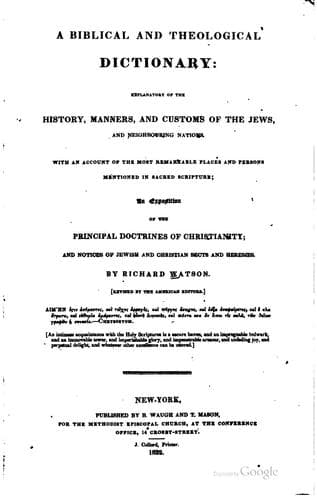
A Biblical and Theological Dictionary: explanatory of the history, manners, and customs of the Jews, and neighbouring nationsWatson, Richard
Religion
A Biblical and Theological Dictionary: explanatory of the history, manners, and customs of the Jews, and neighbouring nations
Watson, Richard
Bible -- Dictionaries; Theology -- Dictionaries
and “so dry and barren that it cannot be tilled.” And the most recent
travellers all concur in describing it in similar terms. On the one
side, near to the site of Opis, “the country all around,” says Mr.
Buckingham, “appears to be one wide desert, of sandy and barren soil,
thinly scattered over with brushwood and tufts of reedy grass.” On the
other, between Bussorah and Bagdad, “immediately on either bank of the
Tigris,” observes Mignan, “is the _untrodden desert_. The absence of all
cultivation, the sterile, arid, and wild character of the whole scene,
formed a contrast to the rich and delightful accounts delineated in
Scripture. The natives, in travelling over these pathless deserts, are
compelled to explore their way by the stars.” “The whole country between
Bagdad and Hillah is a perfectly flat and (with the exception of a few
spots as you approach the latter place) _uncultivated waste_. That it
was at some former period in a far different state, is evident from the
number of canals by which it is traversed, now _dry_ and neglected; and
the quantity of heaps of earth covered with fragments of brick and
broken tiles, which are seen in every direction, the indisputable traces
of former population. At present the only inhabitants of the tract are
the Sobeide Arabs. Around, as far as the eye can reach is a _trackless
desert_.”--“Her cities are desolations.” The course of the Tigris
through Babylonia, instead of being adorned with cities, is marked with
the sites of “ancient ruins.” Sitace, Sabata, Narisa, Fuchera, Sendia,
“no longer exist.” A succession of longitudinal mounds, crossed at right
angles by others, mark the supposed site of Artemita, or Destagered. Its
once luxuriant gardens are covered with grass; and a higher mound
distinguishes “the royal residence” from the ancient streets. “Extensive
ridges and mountains, (near to Houmania,) varying in height and extent,
are seen branching in every direction.” A wall, with sixteen bastions,
is the only memorial of Apollonia. The once magnificent Seleucia is now
a scene of desolation. There is not a single entire edifice, but the
country is strewed for miles with fragments of decayed buildings. “As
far,” says Major Keppel, “as the eye could reach, the horizon presented
a broken line of mounds; the whole of this place was a desert flat.” On
the opposite bank of the Tigris, where Ctesiphon its rival stood, beside
fragments of walls and broken masses of brick work, and remains of vast
structures encumbered with heaps of earth, there is one magnificent
monument of antiquity “in a remarkably perfect state of preservation,”
“a large and noble pile of building, the front of which presents to view
a wall three hundred feet in length, adorned with four rows of arched
recesses, with a central arch, in span eighty-six feet, and above a
hundred feet high, supported by walls sixteen feet thick, and leading to
a hall which extends to the depth of a hundred and fifty-six feet,” the
width of the building.
Public-domain text, read in full here on John Shaqi.
Reviews
Reviews
No reviews yet
Be the first to share your thoughts on this work.
Elsewhere in the archive
Join the Discussion
Join the discussion
Sign in to leave a comment or review.
Sign InorCreate an account