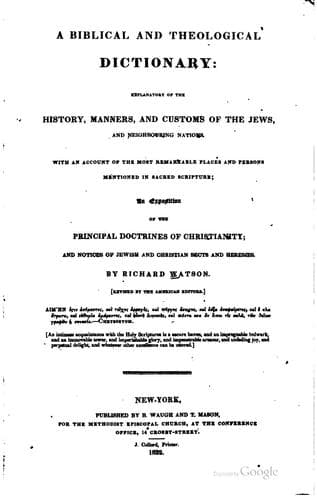
A Biblical and Theological Dictionary: explanatory of the history, manners, and customs of the Jews, and neighbouring nationsWatson, Richard
Religion
A Biblical and Theological Dictionary: explanatory of the history, manners, and customs of the Jews, and neighbouring nations
Watson, Richard
Bible -- Dictionaries; Theology -- Dictionaries
1. Abraham himself with his family may be regarded as a type of the
church of God in future ages. They indeed constituted God’s ancient
church. Not that many scattered patriarchal and family churches did not
remain: such was that of Melchizedec; and such probably was that of
Nahor, whom Abraham left behind in Mesopotamia. But a visible church
relation was established between Abraham’s family and the Most High,
signified by the visible and distinguishing sacrament of circumcision,
and followed by new and enlarged revelations of truth. Two purposes were
to be answered by this,--_the preservation of the true doctrine of
salvation in the world_, which is the great and solemn duty of every
branch of the church of God,--and _the manifestation of that truth to
others_. Both were done by Abraham. Wherever he sojourned he built his
altars to the true God, and publicly celebrated his worship; and, as we
learn from St. Paul, he lived in tents in preference to settling in the
land of Canaan, though it had been given to him for a possession, in
order that he might thus proclaim his faith in the eternal inheritance
of which Canaan was a type; and in bearing this testimony, his example
was followed by Isaac and Jacob, the “heirs with him of the same
promise,” who also thus “confessed that they were strangers and
pilgrims,” and that “they looked” for a continuing and eternal city in
heaven. So also now is the same doctrine of immortality committed to the
church of Christ; and by deadness to the world ought its members to
declare the reality of their own faith in it.
2. The numerous natural posterity promised to Abraham was also a type of
the spiritual seed, the true members of the church of Christ, springing
from the Messiah, of whom Isaac was the symbol. Thus St. Paul expressly
distinguishes between the fleshly and the spiritual seed of Abraham; to
the latter of which, in their ultimate and highest sense, the promises
of increase as the stars of heaven, and the sands of the sea shore, are
to be referred, as also the promise of the heavenly Canaan.
Public-domain text, read in full here on John Shaqi.
Reviews
Reviews
No reviews yet
Be the first to share your thoughts on this work.
Join the Discussion
Join the discussion
Sign in to leave a comment or review.
Sign InorCreate an account